
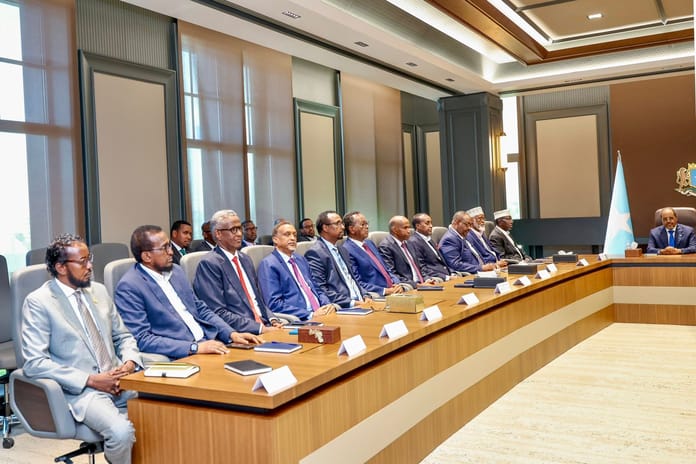
Mogadishu (Somalia Today) – A coalition of Somali regional leaders and opposition figures announced Saturday they would resume direct talks with President Hassan Sheikh Mohamud, easing a political standoff over disputed elections and constitutional reform.
The Somali Future Council, an alliance including the leaders of the semi-autonomous states of Puntland and Jubbaland alongside the Salvation Forum, reversed an earlier decision to boycott direct meetings with the president.
Following closed-door talks inside the heavily fortified Halane green zone at Mogadishu’s airport, the group said it was ready to sit down with Mohamud on Sunday.
“We will meet directly with the president and anyone he brings to the dialogue,” the council said in a statement, abandoning demands that Mohamud first meet with a designated ministerial committee.
The shift follows two days of stalled negotiations over the format of the talks, which had heightened fears of political violence in the fragile Horn of Africa nation.
Intelligence mediation
The breakthrough came after intensive, behind-the-scenes mediation by Somalia’s intelligence chief.
A security official, speaking on condition of anonymity, told Somalia Today that National Intelligence and Security Agency (NISA) director Mahad Mohamed Salad had been shuttling between the rival factions since Friday to broker a compromise.
The council said it had agreed to set aside technical disputes over the electoral model for now. Instead, Sunday’s talks at the presidential palace, Villa Somalia, will focus on the “overall substance” of the upcoming vote.
Despite the procedural thaw, the opposition coalition laid out rigid demands ahead of the meeting, signaling that core disagreements remain unresolved.
In a three-point resolution, the council declared that Somalia’s 2012 provisional constitution remained the only valid legal framework, dismissing recent government-backed amendments as “null and void.”
It also demanded that regional administrations whose mandates have expired hold indirect elections immediately, rather than extending their terms.
Finally, the coalition urged the federal government to ensure a national vote takes place on its scheduled timeline.
‘One-person, one-vote’
The standoff highlights deep, historical divisions over Somalia’s governance and its fraught transition away from a complex, indirect electoral system.
For decades, the country has relied on the “4.5 formula,” a power-sharing mechanism that divides political representation among Somalia’s four major clans and a coalition of smaller ones. Dismantling this system threatens entrenched regional power bases.
In March 2024, the federal parliament approved sweeping constitutional amendments designed to shift the country toward direct, universal suffrage and expand presidential powers.
Critics accused Mohamud of attempting to concentrate authority in the executive branch. In response, oil-rich Puntland withdrew its recognition of the federal government, demanding a nationwide referendum on the changes.
Tensions boiled over last month when scuffles and shouting erupted in parliament over proposed amendments that opposition lawmakers warned would unconstitutionally extend political mandates. The session was ultimately suspended.
Mohamud has vigorously championed the “one-person, one-vote” model. If successful, it would mark Somalia’s first nationwide direct election since 1969, shortly before military dictator Siad Barre seized power in a coup.
Fractured transition
The government tested the new system by holding municipal elections in Mogadishu in December under heavy security, intending to pave the way for national polls.
“It shows Somalia is standing on its feet and moving forward,” national electoral commission member Abdishakur Abib Hayir said of the Mogadishu vote.
But the broader democratic transition has been heavily fractured. Puntland and the self-declared republic of Somaliland boycotted the Mogadishu vote entirely.
Further complicating efforts to build a national consensus, Puntland and Jubbaland boycotted a critical National Consultative Council meeting in May 2025.
Follow-up talks in Kismayo in October between Mohamud and Jubbaland President Ahmed Madobe also collapsed over how to align federal and regional election timelines.
The political gridlock is unfolding as Somalia faces a devastating humanitarian crisis, adding more pressure on the federal government.
Successive, severe droughts have ravaged the country, wiping out livestock and destroying crops. At the same time, cuts to international aid risk pushing millions toward famine.
Looming famine
The UN World Food Programme (WFP) warned on Friday that its emergency food and nutrition aid in Somalia could stop by April unless it quickly gets new funding.
About 4.4 million people in Somalia face crisis-level food insecurity, and nearly one million are suffering severe hunger, according to the latest data from the Integrated Food Security Phase Classification (IPC).
“The situation is deteriorating at an alarming rate,” Ross Smith, WFP’s director of emergency preparedness and response, said in a statement.
For President Mohamud, who is also fighting a stubborn and deadly insurgency by the al-Qaeda-linked militant group al-Shabaab, Sunday’s talks are a key turning point.
He faces two big challenges: keeping his election plan on track and convincing rival regional leaders that constitutional changes will not upset the balance of the federal system—while the risk of mass starvation keeps growing across the country.


