
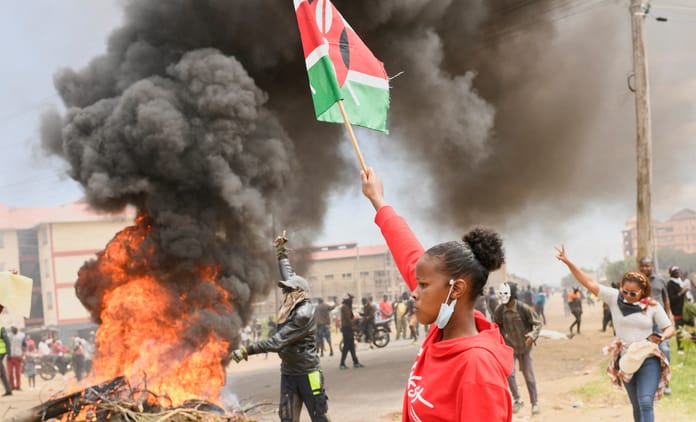
Nairobi (Somalia Today) – Kenyan President William Ruto has defended plans for a US-backed Ebola quarantine facility at a military air base in central Kenya, saying the project is part of national emergency preparedness after protests over the plan turned deadly.
Two people were killed on Monday during demonstrations in Nanyuki, near Laikipia Air Base, a protest organiser and a security source said. The circumstances of their deaths were not immediately clear.
The proposed 50-bed unit has triggered a backlash from residents, lawyers, doctors and local leaders, who say the government has not explained why Kenya should host Americans who may have been exposed to Ebola during the outbreak in the Democratic Republic of Congo and Uganda.
Ruto, speaking publicly about the facility for the first time late on Monday, said Kenya had a duty to prepare for any possible Ebola cases and rejected claims that the site posed an unusual risk.
“We know what we are doing,” he told reporters in northern Kenya.
Court challenge
Kenya’s High Court last week temporarily suspended the plan after a legal challenge argued that the arrangement could endanger public health and had been implemented without sufficient public consultation.
The order barred the government from admitting anyone exposed to or infected with Ebola under the planned arrangement until the court hears the case.
In a fresh ruling on Tuesday, High Court Judge Patricia Nyaundi ordered the authorities to disclose the full terms of any agreement, memorandum, arrangement or negotiations with the US government over the proposed facility.
She also directed the government to publish details of any public health, environmental, biosafety or security assessments carried out, as well as approvals obtained from parliament and other regulatory bodies.
The judge said the protocols intended to govern the admission, handling, isolation and treatment of people exposed to Ebola must also be made public.
The orders were issued in a case filed by a human rights group and the Law Society of Kenya seeking to block the establishment of the isolation unit or the entry of Ebola patients into Kenya.
Ruto did not mention the court order in his remarks.
He said he approved the facility after US President Donald Trump asked Kenya to support the plan, citing decades of cooperation between Nairobi and Washington on health programmes, including HIV/AIDS, Ebola and COVID-19.
The president said Kenya had prepared isolation, surveillance and treatment facilities in 23 counties and insisted the Laikipia site would not only serve foreign partners.
Health Minister Aden Duale has also defended the project, saying: “The Laikipia facility is for everybody.”
“Let us not politicise it,” Duale said, adding that Kenya had trained more than 1,000 health workers and was setting up quarantine, isolation and treatment centres across the country.
Deadly protest
Opposition has grown in Laikipia County, where hundreds of residents marched to the gates of the air base on Monday, chanting anti-Ebola slogans.
Local leaders said residents feared the facility could expose the community to Ebola and questioned why Kenya should take on the risk for US citizens.
Laikipia Governor Joshua Irungu has opposed the centre, warning: “This will expose our people to Ebola.”
The Katiba Institute, one of the groups challenging the plan, said the arrangement raised “grave constitutional concerns” regarding the rights to life, health, public participation, and parliamentary oversight.
A US military C-130 transport plane flew into Nanyuki as recently as Friday afternoon, according to flight-tracking service Flightradar24.
Two Nanyuki residents also reported seeing military aircraft flying towards the base over the weekend, though Reuters could not confirm whether they were US aircraft.
Regional outbreak
The dispute comes as the DRC and Uganda battle an outbreak of the rare Bundibugyo strain of Ebola, which the World Health Organisation declared a public health emergency of international concern in May.
Health officials confirmed the outbreak in Ituri province in northeastern DRC after clusters of unexplained deaths, including among health workers. Cases were later confirmed in Uganda among people who had travelled from DRC.
The outbreak has outpaced parts of the international response, with health officials warning that conflict in eastern Congo, population movement and weak surveillance could hide the true scale of infections.
US officials have said the Kenyan facility would serve Americans exposed to the virus but not yet showing symptoms.
Patients who develop symptoms would be transferred for treatment outside the United States, according to US officials.
Washington has said it plans to commit $13.5 million to Kenya’s Ebola preparedness efforts.
The plan has also drawn criticism from US public health figures. Former CDC officials and other medical experts warned in an open letter to Congress that treating exposed Americans overseas raised “profound clinical, ethical, operational, and legal concerns”.
Ruto said Kenya had tightened screening at land and air borders and was screening about 3,000 people a day. He said Kenya had not detected any Ebola case.
“We are a responsible government,” he said.


