
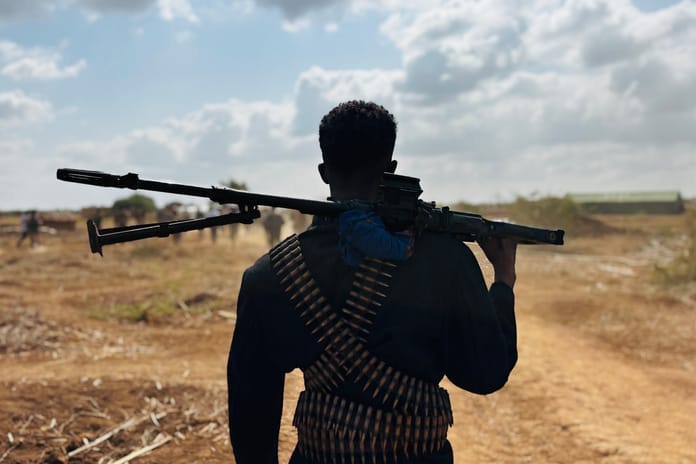
Mogadishu (Somalia Today) – Somalia’s government says US-backed airstrikes and expanded ground operations have shifted momentum in its long-running war against Al-Shabaab, claiming key territorial victories as the country braces for the departure of African Union peacekeepers.
The battlefield assessment comes at a pivotal moment for the Horn of Africa nation.
Nearly two decades after the Al-Qaeda-linked insurgents emerged as a dominant force, AU troops are drawing down, leaving Somali forces to shoulder the burden of national security.
Officials in Mogadishu say sustained American airpower, paired with a renewed ground offensive, has broken a stalemate that had largely favoured the militants.
“We have reclaimed areas that had been under the militants’ control for years,” Omar Ali Abdi, Somalia’s state minister for defence, told Associated Press, citing successes in the Lower Shabelle, Hiiraan, and Jubbaland regions.
Government troops have retaken long-time Al-Shabaab strongholds, including Jilib Marka, Gendershe, and Dhanaane in Lower Shabelle, Abdi said.
He also claimed gains in the central Hiiraan region—specifically the towns of Taydaan and Yasooman—and cited operations in the coastal Kudhaa area where US-trained Danab special forces reportedly killed dozens of militants and seized vehicles.
“Recent air operations destroyed facilities used to manufacture improvised explosive devices (IEDs) and neutralised explosive-laden vehicles before they could be deployed,” Abdi said.
Somali intelligence services are now providing verified targeting information to their American partners, he added.
Al-Shabaab has not confirmed the losses. Access to the contested rural zones remains restricted, making independent verification of battlefield claims difficult.
‘Total war’
The offensive forms part of the “total war” declared by Hassan Sheikh Mohamud shortly after his election in 2022. It has seen the government mobilise local clan militias—known as “Macawisley”—to fight alongside the national army.
Crucial to this push has been the return of US support.
In 2020, then-President Donald Trump ordered the withdrawal of most US troops from Somalia. However, President Joe Biden approved their redeployment in 2022, restoring a sustained advisory presence and intensifying the air campaign.
“The expansion of aerial surveillance and strike capability altered what had previously been a more evenly matched fight,” said Abdullahi Ahmed Ali, a security analyst based in Mogadishu.
In earlier phases of the conflict, both government forces and insurgents possessed similar ground weaponry. But Ali noted that expanded drone coverage has allowed security forces to expose Al-Shabaab’s underground hideouts and supply routes.
“Once these locations were targeted from the air, it was easier for the government troops to advance into those areas,” he said.
United States Africa Command, which coordinates strikes with the federal government, says it assesses the risk of civilian harm before operations.
Rights groups have frequently criticised the US air campaign for civilian casualties, allegations AFRICOM says it investigates.
Fragile gains
Despite the government’s optimism, the security landscape remains volatile.
Al-Shabaab, estimated to have between 7,000 and 12,000 fighters, has proven remarkably resilient.
AU forces pushed the group out of Mogadishu in 2011, but it quickly adapted, reverting to guerrilla warfare, suicide bombings, and targeted assassinations.
It continues to raise millions of dollars annually through a sophisticated network of tax evasion and extortion, according to United Nations monitors.
Recent months have shown the group is still capable of striking the capital.
In March 2024, militants staged a complex attack on the SYL Hotel near the presidential palace, and in August, a beachfront assault killed more than 30 civilians, underscoring the enduring threat.
The timing of the current offensive is critical.
The African Union Transition Mission in Somalia is in the final stages of a phased withdrawal and is expected to hand over full security responsibilities to Somali forces by the end of 2024.
A new, smaller force—the African Union Support and Stabilisation Mission in Somalia— replaced it in 2025.
However, the transition is fraught with geopolitical tension.
Disputes between Somalia and neighbouring Ethiopia—historically a key troop contributor—have led Mogadishu to seek deeper security ties with Egypt.
Cairo began shipping arms to Somalia in January 2024, following the lifting of a decades-long UN arms embargo in December 2023.
Analysts warn that while the lifting of the embargo allows Somalia to better equip its forces, it also raises the risk of weapons diversion in a country awash with illicit arms.
Governance challenge
Beyond the military maneuvering, Somalia faces overlapping crises, including climate-related shocks.
After surviving a historic drought, the country has faced El Niño-driven floods that have displaced hundreds of thousands and complicated humanitarian access to liberated areas.
Security experts caution that military victories often prove fleeting without immediate governance follow-up.
In previous offensives, Al-Shabaab fighters have simply melted into the bush, only to return once government forces withdraw.
“Territorial gains must be consolidated through governance and services,” said one Mogadishu-based diplomat who requested anonymity.
“If the state cannot provide justice and water, Al-Shabaab will return.”
The government insists it has learned from past mistakes.
Minister Abdi said there were plans to rebuild homes and deliver aid to newly captured towns to prevent the militants from re-establishing control.
“Operations will continue in coordination with international partners, combining ground offensives, intelligence gathering, and reconstruction,” Abdi said.
For now, the momentum appears to be with the government, but the ultimate test lies ahead: whether Somalia’s nascent security forces can hold the line on their own as international peacekeepers pack their bags.
“That depends on Somalia’s ability to secure and govern territory,” said analyst Ali.
“Winning the town is the easy part. Holding it is the war.”


