
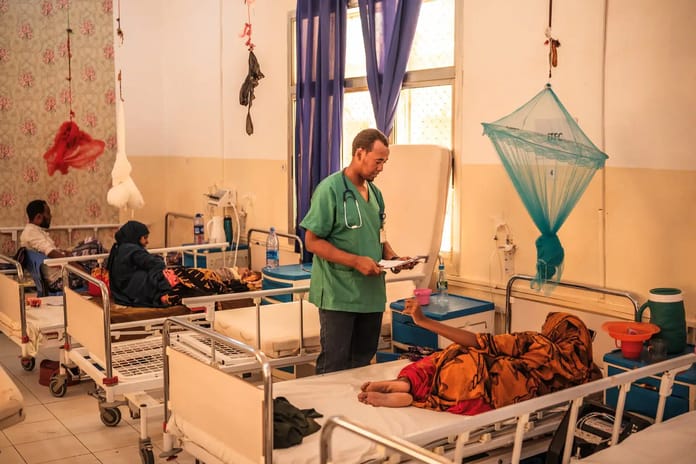
Baidoa (Somalia Today) — A devastating health crisis is unfolding in southern Somalia, with children arriving at clinics sicker and thinner than ever, The New York Times reports.
Aid groups said Wednesday the spike in severe malnutrition is a direct result of drastic cuts to US humanitarian funding.
The funding cuts have forced dozens of community health clinics and feeding centers to close. This leaves hundreds of thousands of people without care. Save the Children, a major aid provider, shut 47 of its 128 Somali facilities in March. The closures left more than 300,000 people, including displaced families in Baidoa, without health services.
Somalia has faced decades of civil war and a persistent insurgency by Al Shabab militants. The UN-backed IPC group warned in September that 3.4 million Somalis face “crisis” levels of food insecurity.
According to the UN, a severe funding gap for aid now compounds the crisis. This is happening as top donors, led by the US, reduce support.
‘Severe’ complications
In Baidoa, a city swollen by displaced families, the impact is stark. Dr. Abdullahi Yusuf is the medical director at Bay Regional Hospital. He said malnutrition admissions rose 40 percent by July compared to January.
“Previously we had early referrals… now they come late and the complications are much more severe, and so the deaths are higher,” he said.
The hospital, supported by Doctors Without Borders (MSF), now sees cases of diphtheria—once rare—almost daily. Dr. Yusuf said 50 cases appeared in the last three months, compared to one or two per year previously.
The US has been Somalia’s largest humanitarian donor, providing an average of $450 million annually over the past decade. That figure was $481 million in 2020, according to internal State Department data reviewed by The New York Times.
For the 2025 fiscal year, which ended September 30, that figure was about $128 million. The State Department issued a statement on October 9. It said the Trump administration had approved $14.9 million in new funding.
It stated that both military and humanitarian assistance continue.
“The United States remains committed to working with Somalia to counter terrorist threats,” the statement said. It added that the US has contributed “more than its fair share.”
The State Department statement said it “will continue its mission to encourage other donors… to come up with sustainable solutions for those most in need.”
Agonizing aid choices
Aid groups described agonizing choices. Dr. Binyam Gebru is Save the Children’s director in Somalia. He said the non-renewal of an eight-year USAID grant forced them to make a choice. They had to decide between community feeding programs and emergency centers.
“Of course, lifesaving intervention should be prioritized, and that’s what we have done,” Dr. Gebru said. “But it’s devastating.”
“You know that in the community, you could treat a child for a few dollars, and very quickly,” he added.
For mothers in Baidoa’s camps, the cuts mean desperation. Owliyo Ali, whose 18-month-old son is severely underweight, used to get fortified foods from a nearby clinic. That clinic is now closed.
Her son recently developed a measles rash and high fever. She had to borrow for a $3 taxi ride to the main hospital. The fare is three times her husband’s typical daily earnings.
Funding gaps widen
The US cuts are part of a wider funding decline.
“Most of our key donors — the Dutch, the Germans, the Brits — it’s all coming down,” said Crispen Rukasha of the UN’s humanitarian office (OCHA) in Somalia.
Britain, the second-largest health donor, will end its health funding in March. The World Food Programme (WFP) said it will be forced to make cuts. Emergency food aid recipients will drop to 350,000 next month, down from 1.1 million in August.
Somalia’s government has little capacity to fill the gap. It collected $350 million in revenue last year, spending most on security to fight Al Shabab militants. Donors cover 60 percent of all health spending.
Dr. Ibrahim Adam Somow, the health ministry’s director general, called the situation “like rebuilding a building: everyone must bring a brick.” He said Somalia is a long way from being able to cope on its own.
Dr. Gebru warned the aid cuts risk reversing years of public health gains. “Good things were happening,” he said. “But one such aid cut… will reverse everything we have done for years.”


