
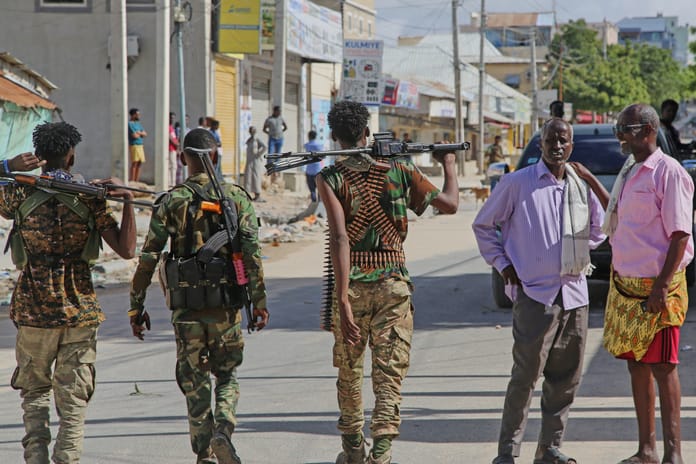
Mogadishu (Somalia Today) — Somalia’s government said security forces had completed a 48-hour operation in Mogadishu on Friday, as former president Sharif Sheikh Ahmed left a flashpoint area after days of clashes between Somali forces and opposition-linked fighters.
Political sources said Sharif, who had been staying in the Mirinaayo area of Abdiasis district, was returning to his residence near Aden Adde International Airport after mediation efforts involving elders, government representatives and other intermediaries.
The move came a day after former prime minister Hassan Ali Khaire also left a residence in Howlwadaag district following talks with senior government officials, including National Intelligence and Security Agency chief Mahad Salad.
Khaire was persuaded to return to his residence near Jazeera Hotel, with NISA personnel expected to help secure him, according to local sources.
The two moves marked the first major sign of de-escalation since armed clashes broke out in Mogadishu, raising fears that Somalia’s political dispute over elections and President Hassan Sheikh Mohamud’s continued stay in office could spill into wider urban conflict.
Operation completed
The Ministry of Information said security forces had completed an operation aimed at preventing what it called organised militias from creating insecurity in the capital.
It said armed groups carrying heavy weapons had entered neighbourhoods in Mogadishu and later attacked police forces and civilians.
The ministry said security forces had dealt “carefully” with the armed groups, which it said had been organised by politicians including Khaire and Sharif.
During the operation, it said, security forces seized weapons from what it described as illegal militias. Security agencies and judicial authorities had opened formal investigations, and anyone found to have taken part would be brought before justice, it added.
“The Somali government considers such acts unacceptable, outside the law and a response to hostile internal and external interests,” the statement said.
The government said it would not tolerate militias or illegal weapons, warning that anyone involved in similar acts would face “firm and legal measures”.
It also thanked security forces for what it called their role in restoring security in the capital, and praised the Somali public and international partners for their support.
Sharif leaves Mirinaayo
Sharif’s decision followed days of tension around Abdiasis, where the former president had remained despite pressure from elders and other intermediaries to leave the area and return to the airport zone.
Sources familiar with the mediation told Somalia Today that Sharif had insisted that his private security detail must not be removed and that he would defend himself against any attack.
That demand had been one of the most sensitive points in talks between the sides.
The exact reason for Sharif’s change of position was not immediately clear. As late as Thursday night, he had resisted calls to leave Mirinaayo, according to people familiar with the discussions.
By Friday, however, Mogadishu appeared calmer than in the previous two days, when troop movements, gunfire and clashes in several neighbourhoods caused fear among residents.
Sharif earlier accused government forces of targeting his residence during the confrontation.
“The government forces encircled and attacked my house,” Sharif said in a video posted online. “I am never scared of their aggressive attack. I will fight back.”
He also accused Mohamud’s administration of illegally altering the constitution, a charge at the centre of the wider political dispute.
The government rejects opposition claims that it is acting unlawfully and says its electoral agenda aims to move Somalia towards direct elections after decades of indirect, clan-based voting.
Khaire clash
The latest de-escalation followed intense fighting involving forces loyal to Khaire, one of Mohamud’s most vocal opponents.
Somali forces and opposition-aligned fighters exchanged fire in Howlwadaag and Abdiasis from Wednesday evening into Thursday morning, damaging property and forcing civilians to flee.
Residents reported heavy gunfire, explosions and mortar fire in populated areas, while local accounts said the clashes caused deaths and injuries. No official casualty toll has been released.
Khaire accused Mohamud of ordering what he called a “sustained and indiscriminate military assault” intended to kill him, Sharif, traditional elders and other political figures.
“Heavy weaponry more commonly associated with conventional battlefield operations than densely populated urban areas, including anti-tank weapons, drones, and other military assets, has been deployed against us,” Khaire said.
The government rejected the opposition’s account and blamed the violence on armed groups linked to Khaire and Sharif.
Talks gain ground
The latest moves by Sharif and Khaire suggest mediation efforts have made progress after two days of armed tension in the capital.
Sources said government envoys had accepted most of the points raised by opposition figures, although the situation remained fragile and could change quickly.
The government also faces political pressure because any agreement that allows opposition leaders to keep their armed protection could be seen by critics as a retreat after the military escalation.
Preliminary meetings were expected in Mogadishu on Friday to discuss the political crisis and wider disputes over the country’s electoral path.
Somali political sources said Türkiye was also taking a mediation role, building on Ankara’s long-standing relationship with Mogadishu and its growing role as a diplomatic actor in Somali affairs.
The United States, Britain and the regional bloc IGAD have urged Somali leaders to avoid further violence and resolve their differences through dialogue.
The US Embassy in Mogadishu called the violence “reckless” and said Somali leaders on all sides had a responsibility to preserve stability.
“Somali leaders on all sides have a responsibility to preserve stability and resolve differences through peaceful means,” the embassy said.
Britain said it was “deeply concerned” by the violence and called on all parties to exercise restraint, while IGAD urged immediate de-escalation and “maximum restraint”.
Echoes of 2021
The standoff has revived memories of Somalia’s 2021 political crisis, when an attempted term extension under then-president Mohamed Abdullahi Farmaajo triggered armed clashes in Mogadishu and split parts of the security forces.
That crisis ended only after parliament reversed the extension, and Somalia returned to an indirect electoral process.
This time, the dispute centres on constitutional amendments and the timing of elections. Mohamud’s allies say the changes are needed to complete Somalia’s transition towards one-person, one-vote elections.
Opposition leaders say the process lacks consensus and risks extending the president’s time in office without a broad political settlement.
For now, the immediate danger in Mogadishu has eased. But the political dispute that brought Sharif and Khaire into confrontation with the government remains unresolved, leaving the capital calm but still exposed to another sudden escalation.


