
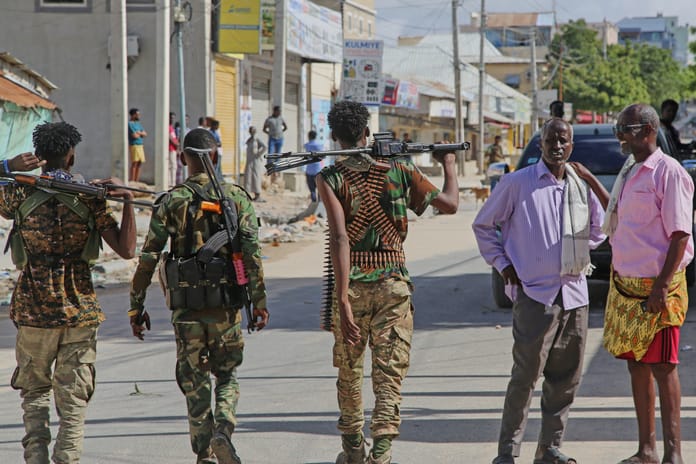
Mogadishu (Somalia Today) — Former Somali prime minister Hassan Ali Khaire left a residence in Mogadishu’s Howlwadaag district on Thursday after clashes between government forces and fighters linked to him deepened a political crisis over elections and President Hassan Sheikh Mohamud’s disputed mandate.
Sources told Somalia Today that senior government officials, led by National Intelligence and Security Agency chief Mahad Salad, visited the house where Khaire had been staying and persuaded him to return to his residence near Jazeera Hotel.
The sources said NISA personnel would help secure Khaire after hours of tension in the capital, where fighting erupted between government troops and armed men loyal to the former prime minister.
The confrontation, which caused deaths and injuries according to local accounts, marked one of the most serious escalations in Mogadishu since opposition leaders began mobilising against Mohamud’s continued stay in office.
Khaire, a former ally of Mohamud who later became one of his most vocal critics, has been among opposition figures accusing the president of remaining in power after his mandate expired.
Fighting in Howlwadaag
The violence centred on Howlwadaag, a densely populated district in central Mogadishu that has long carried political and security weight because of its proximity to key government areas and opposition networks.
The Somali government said armed opposition fighters had entered the area overnight and later attacked a police facility belonging to the Howlwadaag district police station.
In a statement, the Ministry of Information said the fighters had concealed their identities, carried heavy weapons and had been organised by Khaire.
“These armed opposition group militia members, armed with heavy weapons, directly targeted a police facility,” the ministry said.
It said heavy weapons carried by the group were also fired into residential neighbourhoods inhabited by civilians.
The government said it would not tolerate attempts to undermine security in the capital, disrupt the work of security forces or create fear among residents.
It added that security agencies had opened a formal investigation and that legal measures would be taken against anyone found to have been involved.
‘Assasination attempt’
Opposition figures rejected the government’s account and accused the authorities of using force to suppress political opponents.
Khaire accused Mohamud of directing what he called a sustained and indiscriminate military assault for more than 20 hours, saying the apparent objective was to kill him, former president Sharif Sheikh Ahmed, traditional elders and other political leaders in Mogadishu.
“Heavy weaponry more commonly associated with conventional battlefield operations than densely populated urban areas, including anti-tank weapons, drones, and other military assets, has been deployed against us,” Khaire said.
He also accused the government of targeting civilian infrastructure, saying electricity supplies serving thousands of civilians had been deliberately disrupted. “This conduct constitutes a war crime under international law,” he said. The government has rejected opposition accusations and blamed the violence on armed groups linked to Khaire.
Khaire said weapons entrusted to the Somali state to fight Al-Shabaab had been “turned against Somalia’s own leaders and citizens” in what he called a campaign of political repression and targeted killing.
“We will defend ourselves, our communities, and our constitutional rights,” he said, calling on military, police and security commanders to refuse unlawful orders.
‘Unnecessary violence’
Former president Mohamed Abdullahi Farmaajo said the violence could have been avoided if the government had chosen dialogue instead of confrontation.
“This was truly avoidable and unnecessary,” Farmaajo said, accusing Mohamud of ignoring earlier warnings about the consequences of deepening the political dispute.
Farmaajo said Mohamud’s mandate had expired and accused him of remaining in office unlawfully, a claim the government rejects.
The comments reflected the widening divide between the government and opposition leaders, who say the president and his allies are trying to change the electoral framework without broad political consensus.
The government says its constitutional and electoral agenda aims to move Somalia towards direct elections after decades of indirect voting, clan-based power-sharing and repeated electoral delays.
But opposition leaders argue that reforms introduced without agreement could give Mohamud extra time in office and destabilise a fragile security environment.
Government defends forces
Senior government figures praised the security forces and framed the clashes as a failed attempt to use armed pressure against the state.
Defence Minister Ahmed Moallim Fiqi said what he called the use of “intimidation, force and militias” to seek power or block the government had failed.
He said the “era of warlord leadership” had ended and praised national forces, traditional elders supportive of state institutions and the Somali public for what he described as patience and restraint.
Mogadishu mayor Hassan Mohamed Hussein Muungaab also praised the national army and security agencies, saying they had worked responsibly to maintain security, protect civilians and defend state institutions.
He said the events of the past hours showed a national duty to defend stability, law and state accountability.
Muungaab also thanked residents of the capital for what he called their patience, awareness and cooperation during a sensitive moment.
US, UK and IGAD urge restraint
The clashes also drew warnings from Somalia’s international partners, who urged the government and opposition leaders to pull back from further confrontation.
The US Embassy in Mogadishu called the violence “reckless” and said Somali leaders on all sides had a responsibility to preserve stability.
“Somali leaders on all sides have a responsibility to preserve stability and resolve differences through peaceful means,” the embassy said.
“Actions taken in the coming hours and days may have lasting consequences for Somalia’s security, unity, and future.”
The British Embassy said it was “deeply concerned by reports of violence in Mogadishu overnight”.
“Violence is unacceptable and we call on all parties to exercise restraint and engage in inclusive, constructive dialogue to resolve tensions peacefully,” it said.
IGAD also called for immediate de-escalation, saying it was deeply concerned by reports of violence in Mogadishu amid heightened political tensions.
The regional bloc condemned “all acts of violence” and called on all sides to exercise “maximum restraint” and resolve their differences through peaceful, inclusive and constructive dialogue.
“At this critical moment, preserving peace, stability, national unity, and the gains made in Somalia’s state building efforts is of paramount importance,” IGAD Executive Secretary Workneh Gebeyehu said.
Risk of wider unrest
The clashes revived memories of Somalia’s 2021 political crisis, when a dispute over an extension for Farmaajo’s government triggered armed confrontations in Mogadishu and split parts of the security forces before parliament reversed the move.
The latest confrontation comes as Somalia is still fighting Al-Shabaab, the Al-Qaeda-linked group that controls parts of the countryside and regularly carries out attacks in the capital.
Foreign partners also urged Somali leaders to step back from violence, with the United States, Britain and IGAD calling for restraint, dialogue and de-escalation.
But Thursday’s main test appeared to be inside Mogadishu itself, where Khaire’s relocation reduced the immediate standoff around his Howlwadaag residence but left the wider political crisis unresolved.
For now, both sides are presenting sharply different versions of the same confrontation: the government says it acted against armed opposition militias, while the opposition says the authorities used force to intimidate rivals.
The coming days will show whether Khaire’s move away from Howlwadaag marks the start of de-escalation or only a pause in a dispute that has already brought armed politics back onto the streets of the capital.


