
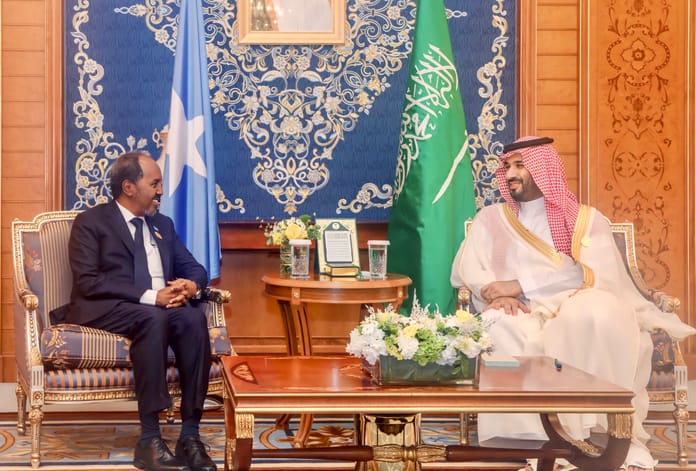
Riyadh (Somalia Today) – Somali President Hassan Sheikh Mohamud has unveiled a “three-pronged” strategy to nullify Israel’s recognition of the breakaway region of Somaliland, warning the move threatens to turn the Horn of Africa into a battleground for proxy conflicts.
In an interview with the influential pan-Arab daily Asharq Al-Awsat, Mohamud said his government was coordinating closely with Saudi Arabia and other regional powers to isolate the self-declared republic and, at the same time, protect the Red Sea corridor from what he termed “reckless Israeli adventurism.”
The diplomatic offensive follows Israeli Prime Minister Benjamin Netanyahu’s controversial announcement in late 2025 recognizing Somaliland as an independent state—a move that, in Mogadishu’s view, upended decades of international consensus on Somalia’s territorial integrity.
“I affirm with the utmost clarity and firmness that any recognition of Somaliland as an independent state constitutes a blatant violation of the sovereignty and unity of the Federal Republic of Somalia,” Mohamud told the newspaper in Riyadh.
He warned that the recognition was not merely symbolic, but instead part of a wider Israeli strategy to secure a military foothold near the Bab al-Mandeb Strait, a choke point for global trade and energy shipments.
‘Three-track’ offensive
Mohamud then outlined a three-part plan to counter the move, which Mogadishu views as an existential threat.
The first track involves mobilizing international legal and diplomatic pressure through the United Nations, the African Union (AU), and the Organization of Islamic Cooperation (OIC).
Somalia, currently holding a non-permanent seat on the UN Security Council, has also recently secured a formal session to address the issue, which Mohamud described as a “significant diplomatic victory.”
The second track focuses on consolidating a unified “Arab, Islamic, and African position.” In that context, Mohamud singled out Saudi Arabia for its “firm and principled” support, noting that Riyadh was among the first to reject the recognition.
“The Saudi position reflects the Kingdom’s longstanding commitment to state sovereignty… and sends an important message to the international community,” he said, while also praising the support of King Salman bin Abdulaziz and Crown Prince Mohammed bin Salman.
The third track involves strengthening internal national dialogue to address grievances within the framework of a single Somali state, aiming in turn to undercut the separatist narrative.
Strategic foothold
Somaliland, a former British protectorate, declared independence from Somalia in 1991 following the collapse of the central government.
While it has maintained relative stability and held democratic elections—most recently electing Abdirahman Mohamed Abdullahi “Irro” in late 2024—it has nonetheless failed to gain widespread international recognition.
Israel’s move to recognize Hargeisa makes it the first UN member state to do so, a decision analysts say is driven by a desire to counter Iranian influence in the Red Sea and, more broadly, monitor Houthi activity in nearby Yemen.
Mohamud was blunt about these geopolitical stakes. “We believe the goal extends beyond a political gesture,” he said. “It includes seeking a strategic foothold in the Horn of Africa… enabling influence over the Bab al-Mandeb Strait.”
He warned that importing Middle Eastern rivalries into the Horn of Africa would have “dangerous” consequences for Red Sea littoral states, including Egypt, Saudi Arabia, and Jordan.
“We will not allow Somalia to become an arena for settling conflicts that do not serve our people’s interests,” he declared.
‘Short-term interests’
Without naming specific countries, Mohamud also took a swipe at regional actors who might view the crisis as an opportunity.
“It is clear that some may view this recognition as a chance to achieve limited gains,” he said, in a veiled reference to nations that have recently deepened commercial ties with Somaliland, such as the United Arab Emirates and Ethiopia.
He cautioned, moreover, that legitimizing secession could set a “dangerous precedent” for the rest of Africa and the Arab world, citing the fragmentation of Sudan and Yemen as warning signs.
For now, Mogadishu is banking on its alliance with Riyadh to hold the line. Mohamud described Saudi-Somali relations as “deep-rooted and strategic,” emphasizing that the Kingdom remains a central partner in Somalia’s reconstruction and security architecture.
“Preserving Somalia’s unity is a cornerstone of collective Red Sea security,” he said


