
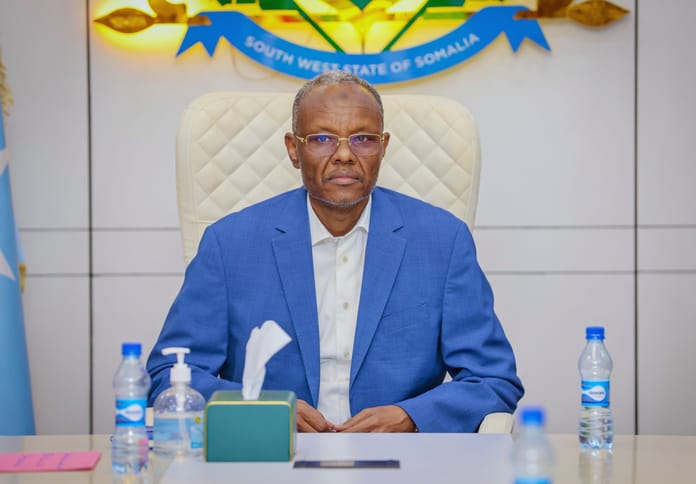
Baidoa (Somalia Today) — The president of Somalia’s South West State resigned on Monday and left for Kenya after federal troops took control of Baidoa, ending a standoff with Mogadishu that has deepened tensions over power, elections, and constitutional reform.
Abdiaziz Hassan Mohamed, widely known as Laftagareen, announced his resignation in a brief statement posted on Facebook shortly before departing from Baidoa’s Shaati Gaduud airport, according to local officials and residents.
“Effective today, March 30, 2026, I have resigned from the position of President of the South West State,” Laftagareen said in the statement.
His exit followed the entry of federal troops and allied local fighters into the regional capital after days of military and political pressure that brought about a rapid collapse in his authority.
Sources familiar with the talks told Somalia Today federal officials had initially wanted Laftagareen taken to Mogadishu, but that after hours of negotiations, an agreement was reached allowing him to travel to Nairobi in exchange for a peaceful handover.
The resignation appeared to nullify a disputed re-election he had held only days earlier in Baidoa, a move rejected by Mogadishu and opposed by his rivals.
Federal takeover
Residents said federal soldiers took over the police headquarters, key intersections, and major commercial areas after entering the city earlier in the day with little resistance in the centre.
Forces loyal to Laftagareen were reported to have withdrawn from their positions as government troops consolidated control, while many streets were largely deserted after families fled for fear of fighting.
In a statement issued late Monday, the federal government said it had assumed full control of Baidoa, the interim capital of South West State, after operations by the Somali National Army and allied forces.
It said troops had reopened the main road linking Mogadishu and Baidoa after clearing it of Al-Shabaab militants, and that security operations were continuing inside the city.
“Security officers are inside the city of Baidoa conducting operations to ensure security, after the city was cleared of militias misled by the former leader of the South West administration,” the statement said.
The advance on Baidoa followed clashes near Daynunay, outside the city, where Somalia’s defence ministry said government troops had been carrying out operations against Al-Shabaab before coming under attack from armed groups allegedly linked to the regional leadership.
Federal authorities said troops then continued their push towards Baidoa and secured the city later in the day.
Residents said hundreds of people gathered in parts of the city and its outskirts to welcome the arrival of government forces, though the atmosphere remained tense as soldiers fanned out across key installations and security officials began patrols.
Avoiding a vacuum
Before leaving, Laftagareen signed a decree appointing South West finance minister Ahmed Mohamed Hussein as acting president, saying the move was intended to avoid a constitutional vacuum.
The decree said Hussein would serve until “a final solution” was reached, citing the “complex situation”, unrest in the region, and uncertainty surrounding the administration.
Whether the appointment will carry practical weight remained unclear by Monday night, with federal troops controlling Baidoa and Mogadishu expected to play a decisive role in shaping the next political arrangement in South West State.
Baidoa, around 245 kilometres northwest of Mogadishu, is one of Somalia’s most strategically sensitive cities. It hosts African Union peacekeepers and humanitarian agencies and lies in a region affected by drought, displacement, and insurgent violence.
The city is also a major political and administrative centre in the south of the country, making its fall a significant setback for Laftagareen and a major gain for President Hassan Sheikh Mohamud’s government.
Aid agencies had already reduced some activity in recent days as tensions sharpened, underscoring concern that the confrontation could worsen humanitarian conditions in a region already under heavy strain.
Long-running tensions
The crisis had been building for weeks.
On March 17, South West State announced that it was suspending all cooperation and relations with the federal government, in the clearest sign yet of a widening split between Baidoa and Mogadishu.
That move followed growing accusations from the regional administration that Mogadishu was interfering in local politics, arming rival forces, and seeking to unseat Laftagareen.
Tensions had already risen sharply after Somalia’s federal parliament approved constitutional amendments earlier this month.
Critics said the changes were pushed through without broad political consensus and would strengthen the presidency at the expense of the federal member states.
Supporters of the reforms said they were needed to move Somalia away from its long-running indirect electoral system and towards a more stable constitutional order.
Laftagareen emerged as one of the most vocal regional critics of the changes, accusing Mohamud’s administration of trying to centralise power.
Federal authorities, in turn, signalled that they no longer recognised decisions taken by his administration, arguing that his mandate had expired.
The standoff widened into open confrontation as federal troops and allied fighters known as the South West Salvation forces advanced across the region and seized a series of key towns before moving on Baidoa.
Fragile federal system
Laftagareen had led the region for more than seven years. His rise to power in 2018 was itself highly contentious.
He won the South West presidency in a vote overshadowed by the arrest of former Al-Shabaab deputy leader Mukhtar Robow, a rival candidate whose detention triggered protests in Baidoa in which at least 11 people were killed, according to earlier reports.
The episode left a lasting perception of federal interference in South West politics, a grievance that resurfaced repeatedly during Laftagareen’s tenure and helped shape the current crisis.
His fall is likely to intensify concern over Somalia’s federal order at a time when the country remains under pressure from Al-Shabaab and from wider disputes over constitutional change, elections, and the balance of power between Mogadishu and the regions.
Puntland, in the north, has already withdrawn recognition of the federal government over the constitutional dispute, while Jubaland has also clashed with Mogadishu over elections and power-sharing.
The latest developments are also likely to sharpen fears that political confrontation between federal and regional actors could distract from the campaign against Al-Shabaab, which still controls parts of the countryside and remains capable of launching deadly attacks despite repeated military offensives.
By nightfall on Monday, however, the balance of power in South West State appeared to have shifted decisively.
With Laftagareen gone, Baidoa under federal control, and rival forces dispersed, Mogadishu had secured one of its most significant political and military victories over a regional administration in recent years.


