
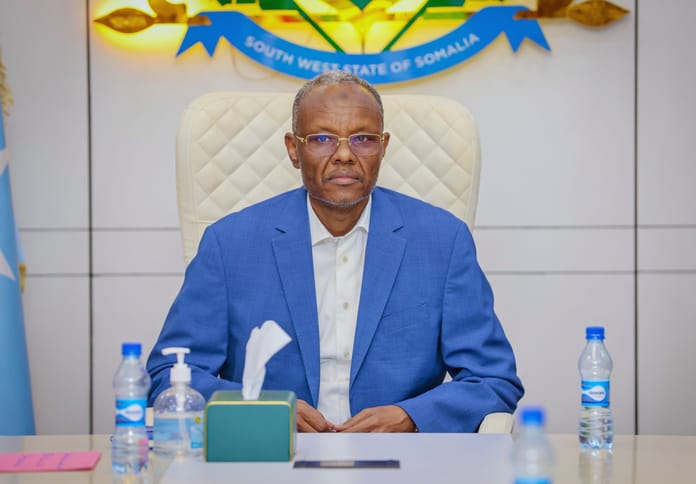
Baidoa (Somalia Today) – Lawmakers in Somalia’s South West state on Saturday re-elected President Abdiaziz Hassan Mohamed Laftagareen in a fast-tracked vote in Baidoa, opening a new front in an escalating confrontation with the federal government, which swiftly denounced the process as illegal and unconstitutional.
The regional parliament, whose new membership emerged overnight, handed Laftagareen another term after first re-electing Ali Said Fiqi as speaker.
Election officials in Baidoa said Laftagareen won 66 votes, defeating challenger Abdullah Haji Hassan. Local reports said Shamsa Mohamed Yarow also won the election as the second deputy speaker.
Opponents dismissed the contest as a sham and a formality, saying the result had been settled before lawmakers cast their ballots in a process completed within hours.
The federal government moved quickly to reject the outcome.
In a statement, the interior ministry condemned what it called an “illegal self-election” in Baydhabo, describing it as “a clear violation of the agreements of the National Consultative Council, the electoral laws and the constitution of the country”.
The ministry said the process did not reflect the will of the people of South West state and argued that what took place “was not a legitimate election” but rather “a naked attempt to mislead the democratic process and impose a pre-determined outcome”.
It added that a process wrapped up within 24 hours, and lacking transparency, free competition, and legality, “cannot be recognised as an election consistent with the constitution and the state system of the country”.
The unusually strong language underlined how sharply relations have deteriorated between Villa Somalia and one of the country’s most politically sensitive regional states.
Troop movements
The dispute has also taken on a dangerous security dimension.
Tension has been building for days around Burhakaba, a strategic town east of Baidoa, where sources have reported troop movements by rival forces aligned with the federal government and the South West administration.
Federal troops have reportedly mobilised in Burhakaba, while Laftagareen has deployed heavily armed regional forces on the streets of Baidoa, raising fears that the standoff could slide into direct confrontation.
The Baidoa vote took place against that volatile backdrop, with both sides hardening their public positions and showing no sign of retreat.
President Hassan Sheikh Mohamud sharpened the clash on Saturday in remarks delivered in Mogadishu during the inauguration of the rebuilt Dabka-Bakaraha road.
Without naming Laftagareen directly at first, Hassan said Somalia would not return to its old indirect model, declaring that “the time for indirect elections is over” and that the country was now heading towards one-person-one-vote elections.
He also mocked leaders who had previously endorsed a direct vote but were now retreating from that position.
“A man who made an election agreement with us, and for which we have proof, now rejects our position and says we want indirect elections,” Hassan said. “That period has passed, and there is no going back.”
He insisted that Somalia’s electoral transition had been designed and financed domestically, saying not “a single shilling” had come from foreigners and that no foreign expert had dictated the policy.
His remarks placed the South West election at the centre of a wider national battle over the rules of Somalia’s next polls.
Political class divided
The standoff has exposed deep splits within Somalia’s political elite.
Former president Mohamed Abdullahi Mohamed, better known as Farmaajo, congratulated Laftagareen and said the South West leadership should now speed up reconciliation, the liberation of territories still held by militants, and the expansion of public services.
Former president Sharif Sheikh Ahmed also welcomed the result, saying the election had removed the uncertainty gripping South West institutions and urging other regional administrations whose mandates had expired to organise elections quickly.
Hassan Ali Khaire, former prime minister under Farmaajo, also congratulated both Laftagareen and Fiqi, and called on Galmudug and Hirshabelle to hold regional elections in line with the constitution.
Former intelligence chief Fahad Yasin also sent congratulations, while lawmaker Abdirahman Abdishakur Warsame urged the South West leadership to prioritise dialogue, restore public trust, and commit to an inclusive process that could deliver peace and stability.
The endorsements showed that Laftagareen, despite his rupture with Villa Somalia, retains strong backing among opposition figures and former senior officials who are themselves at odds with the current federal leadership.
Constitutional dispute
Saturday’s vote followed a dramatic collapse in relations between Baidoa and Mogadishu.
On March 17, South West state announced that it was suspending all co-operation with the federal government, accusing the centre of interference and linking the rupture to constitutional and electoral disputes.
Commercial flights between Mogadishu and Baidoa stopped after the break, though humanitarian and United Nations operations continued.
A day later, Laftagareen quit Hassan Sheikh’s Justice and Solidarity Party, widening the crisis from a regional dispute into a direct political split within the president’s own camp.
At the heart of the confrontation is Hassan Sheikh’s push to replace Somalia’s traditional indirect electoral formula with universal suffrage.
The president has argued that indirect voting, under which clan elders and political intermediaries select delegates who then choose lawmakers, has outlived its usefulness and denied ordinary citizens the right to elect their leaders directly.
Opponents do not all reject direct voting in principle, but say the process is moving ahead without sufficient consensus and could reshape the political order in favour of the federal executive.
Those concerns have grown since parliament approved constitutional changes this month that critics say could extend Hassan Sheikh’s term by a year and delay national elections due in 2026.
Echoes of past violence
South West has long been one of the most politically combustible arenas in Somalia’s fragile federal system.
Laftagareen’s rise to power in 2018 came during a crisis overshadowed by the arrest of former Islamist leader Mukhtar Robow, who had been seeking the regional presidency.
Violence erupted in Baidoa after Robow’s detention, leaving at least 11 people dead and turning the election into an early symbol of the struggle between the federal centre and regional power bases.
That history has amplified concern over the latest showdown.
In its statement on Saturday, the federal government said the Baydhabo vote directly violated the legal principles guiding state-building in Somalia and warned that it would deepen long-standing grievances in South West while undermining reconciliation and democratisation efforts.
“The Federal Government of Somalia reaffirms its commitment to defending the constitution, protecting the federal system, and implementing free, fair, and transparent elections that reflect the genuine will of the Somali people,” it said.
With federal and regional forces mobilising, former leaders rallying behind competing camps and Somalia still battling the Al-Shabaab insurgency, Baidoa has once again become the focal point of a wider struggle over elections, power and the future of the federal order.


