
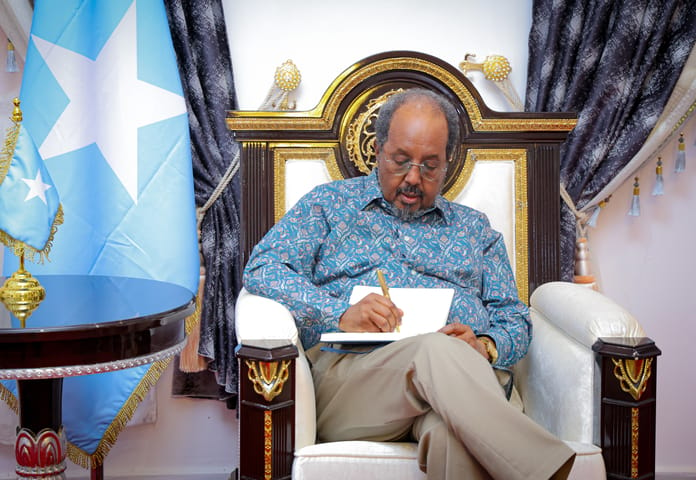
Baidoa (Somalia Today) – Somali President Hassan Sheikh Mohamud wrapped up talks in Baidoa on Wednesday, urging leaders, elders, and residents in South West State to preserve unity after weeks of political upheaval and a federal military intervention in the region.
The meetings, held over several days, brought together regional officials, traditional clan elders, politicians, and civil society figures as Mogadishu sought to calm tensions in one of Somalia’s most politically sensitive federal states.
Mohamud called for compromise and warned against steps that could deepen divisions or undermine stability, the presidency said.
“Preserving stability in the region is essential for creating conditions that allow long-term development and durable state institutions to take root,” it said in a statement.
Senior national figures attended the meetings, including lower house speaker Sheikh Adan Mohamed Nur Madobe and the second deputy speaker, Abdullahi Omar Abshirow, underscoring the importance the federal government attached to the talks.
The visit came after a sharp deterioration in relations between the federal government and South West State, a region that has become the latest front in Somalia’s widening dispute over constitutional reform, elections, and the balance of power between Mogadishu and federal member states.
Baidoa standoff
Tensions escalated last month when authorities in South West State suspended cooperation with the federal government amid growing disagreement over political reforms pushed by Mohamud’s administration.
The dispute later spilled into Baidoa, the regional capital, when federal troops entered the city, shifting the balance of power on the ground.
The intervention effectively ended the administration led by regional president Abdiaziz Hassan Mohamed Laftagareen, raising fears of a wider confrontation in a state that occupies an important place in Somalia’s political and security landscape.
The federal government later moved to install an interim administration, saying the step was intended to avoid a governance vacuum and maintain public services while a new political process was prepared.
Mohamud’s trip to Baidoa was widely seen as an attempt to contain the fallout from the crisis and build support for a negotiated transition rather than allow the standoff to harden further.
Sources close to the presidency said the consultations had produced a preliminary understanding among key actors that could open the way for an agreed electoral process inside South West State.
Electoral dispute
The crisis in Baidoa has highlighted broader tensions over Somalia’s political future.
Mohamud has pushed for a transition from the country’s long-standing indirect electoral model to a one-person, one-vote system, presenting the change as a step towards broader democratic participation.
Somalia has not held a direct national election in decades. Instead, it has relied on an indirect system in which clan elders and delegates help choose lawmakers, who then elect the president.
Under the current arrangement, power has largely been shared through the so-called 4.5 formula, which allocates parliamentary representation among the four major clan families while giving a smaller share to minority groups.
Supporters of reform say the system has outlived its usefulness and entrenched elite bargaining at the expense of wider public participation.
But critics, including some federal member state leaders, say the federal government has moved too quickly and without the broad political consensus needed for such a significant overhaul.
The dispute has been especially sharp in regional states where leaders fear the changes could weaken their influence and strengthen the hand of the centre.
South West State has now become the clearest test of whether Mogadishu can push ahead with its electoral agenda beyond the capital.
Security concerns
Instability in Baidoa carries implications beyond regional politics.
South West State is an important frontline region in the fight against the Al-Qaeda-linked Al-Shabaab insurgency, and security officials have long warned that political infighting can distract from operations against the militant group.
Baidoa is also a major hub for humanitarian operations, hosting large numbers of people displaced by drought, floods, and conflict.
Any prolonged political instability there risks affecting both security coordination and the delivery of aid in surrounding areas.
Against that backdrop, the federal government is trying to present the current transition as a controlled political process rather than a deeper rupture in Somalia’s fragile federal order.
Under the emerging roadmap, voters in South West State are due to head to the polls on April 28 to elect local councils and members of the regional assembly.
Officials say those elections will serve as the basis for establishing a new administration.
Attention will then turn to the election of a new president for South West State.
For the federal government, the Baidoa process will also serve as an early test of whether its electoral plans can move forward in contested political terrain.
Mohamud has since returned to Mogadishu, leaving behind a region still tense but, for now, moving towards a politically sensitive transition ahead of the planned vote.


