
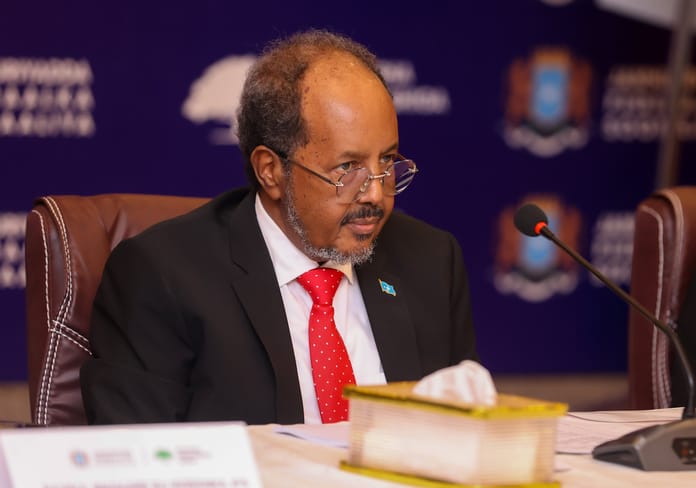
Mogadishu (Somalia Today) – Somali lawmakers have circulated a motion seeking the removal of President Hassan Sheikh Mohamud, marking a fresh escalation in a political crisis that has deepened tensions over constitutional reform, elections, and relations between Mogadishu and regional states.
The document, dated March 24, accuses the president of corruption, abuse of office, and using state power against federal member states.
It emerged just weeks after parliament approved controversial constitutional amendments that critics say could centralise executive power and delay national elections.
The motion also comes soon after a formal rupture between Mogadishu and South West state, underlining the rapid deterioration of Somalia’s fragile federal system.
‘National betrayal’
Addressed to the speakers of both parliamentary chambers and the chief justice, the motion accuses Mohamud of violating the provisional constitution he swore to uphold.
It alleges that the president abused his office, trampled on citizens’ rights, and engaged in acts amounting to what the text describes as “national betrayal”.
Crucially, the document accuses Mohamud of fuelling political conflict by using economic pressure and military force against Somalia’s federal member states.
That language closely mirrors accusations leaders in Baidoa, the administrative seat of South West state, have made in recent days.
On March 17, South West said it was suspending all cooperation with the federal government and accused Mogadishu of arming local militias seeking to remove regional President Abdiaziz Hassan Mohamed Laftagareen.
Commercial flights between Mogadishu and Baidoa stopped after the rupture, although humanitarian flights continued to operate.
The motion also criticises international agreements and economic decisions attributed to the presidency, alleging that they bypassed the legal scrutiny and accountability required by law.
Procedural hurdles
Despite the explosive political nature of the filing, its legal weight remains highly uncertain.
The circulated document appears to contain around 134 names, but it also seems to include members from both the lower House of the People and the Upper House.
Somalia Today could not independently verify the exact number of signatories.
Under Article 92 of Somalia’s provisional constitution, a motion to remove the president must originate from at least one-third of the total membership of the House of the People.
It needs the backing of at least 92 lawmakers from the 275-member lower chamber before it can be formally introduced and referred to the Constitutional Court.
If the court validates the legal grounds for dismissal, removing the president would then require a two-thirds majority vote of the total membership of both chambers.
That makes the filing politically significant but procedurally difficult.
Parliamentary sources say House speaker Sheikh Aadan Mohamed Nur, widely known as Aadan Madobe, has so far refused to officially receive the motion.
Lawmakers quoted by Somalia Today linked the refusal to political efforts underway in Baidoa.
Neither the presidency nor the speaker’s office had issued an official public response by Saturday to the allegations contained in the motion.
Universal suffrage dispute
The motion comes at a sensitive moment for Mohamud, who returned to power in May 2022 after a protracted indirect election.
A central pillar of his second term has been a drive to replace Somalia’s long-running indirect electoral system with universal suffrage.
Somalia has not held direct national elections since 1969, before a military coup and the eventual collapse of the state.
Since 2004, the country has relied on a complex formula in which clan elders and delegates select lawmakers, who then elect the president.
Mohamud’s administration says a return to one-person, one-vote elections is essential to democratic legitimacy and state-building.
In August 2024, cabinet approved a bill aimed at restoring direct voting for the first time in decades.
Mogadishu then held municipal elections in December 2025, which the government presented as a first step towards wider direct voting.
Regional dominoes
Opponents, however, argue that the electoral redesign is moving ahead without sufficient national consensus and could alter the balance of power in favour of the presidency.
Earlier this month, parliament approved constitutional changes that critics say could extend Mohamud’s term by a year and delay elections planned for 2026.
The reform push has also alienated regional leaders who fear the changes will weaken their autonomy and concentrate more power in Mogadishu.
The crisis with South West state forms part of a broader pattern across the federation.
In March 2024, Puntland said it would no longer recognise the federal government until disputed constitutional amendments went to a nationwide referendum.
Jubaland has also clashed with Mogadishu over electoral administration and federal authority.
While the motion faces formidable legal and political obstacles in a parliament where loyalties remain fluid, it signals that confrontations once largely confined to negotiations between Mogadishu and regional leaders are now pressing more directly into national institutions.
For Mohamud, the growing political fragmentation threatens to complicate both his electoral agenda and the federal government’s broader effort to stabilise the country while it continues to battle the Al-Shabaab insurgency.


