
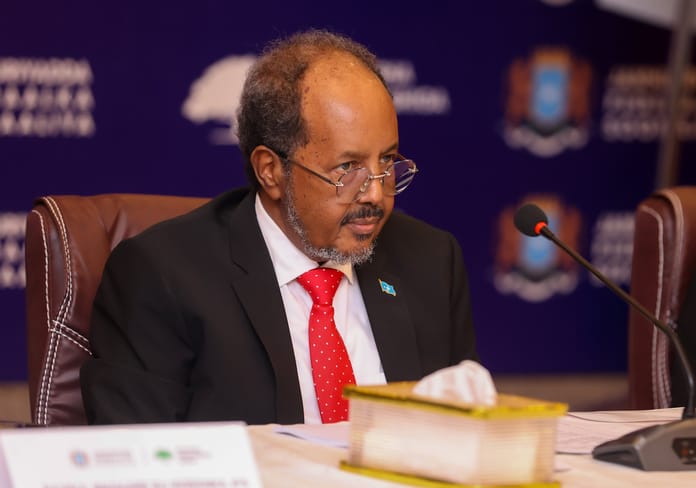
As Somalia’s political elite converged on the southern stronghold of Kismayo this week to issue a strict January 20 deadline to the federal government, the sense of déjà vu across the Horn of Africa nation was palpable.
Five years ago, a bitter dispute over term extensions plunged Mogadishu into severe political violence, sparking street clashes and fracturing the security apparatus.
That crisis followed a parliamentary vote to extend President Mohamed Abdullahi Farmaajo’s term by two years—a maneuver that drew blunt donor pushback and set the capital on a slide toward armed confrontation.
Today, analysts and opposition leaders warn that President Hassan Sheikh Mohamud risks walking into the same trap, though this time through procedural engineering rather than a dramatic legislative decree.
Holding state power imposes a heavier burden of restraint than opposition politics, a duty that becomes most visible when the electoral clock begins to run out.
The “Council of the Future”—a coalition of opposition heavyweights and regional presidents—has given Mohamud 30 days to convene a consensus-based summit.
Their Kismayo communiqué establishes January 20, 2026, as a hard deadline, signaling that his refusal to engage would compel them to initiate a parallel electoral process.
This ultimatum revives fears of a collision course reminiscent of April 2021, when political confrontation rapidly fractured the capital’s security apparatus.
The 2021 precedent
Revisiting 2021 elucidates why the current standoff feels so combustible. After President Farmaajo’s mandate expired and election preparations stalled, parliament pursued a term extension under the guise that more time was needed to organize direct elections.
This legislative maneuver detonated a legitimacy crisis. The “National Salvation” alliance mobilized, security units splintered along clan lines, and Mogadishu witnessed violence serious enough to threaten the state’s collapse.
International partners warned openly that the chaos undermined the fight against Al-Shabaab, a sentiment reflected in urgent statements from the U.S. and the UN at the time.
Under mounting domestic and diplomatic pressure, Farmaajo eventually conceded, annulling the extension.
The lesson was stark: in Somalia, disputes over electoral procedure can transform into disputes over authority overnight—and authority disputes tend to fracture security institutions first.
A bitter reversal
History is repeating itself with a bitter twist of irony. Hassan Sheikh Mohamud, once the vocal opposition leader cheering on the resistance against dictatorship, now faces accusations of engineering a path toward mandate slippage.
Meanwhile, his rivals—some of whom defended delays while in power—vow to resist any extension, whether explicit or technical.
The government’s central argument remains straightforward: Somalia cannot be locked indefinitely in a cycle of indirect selection.
The administration maintains it is pursuing “One Person, One Vote” elections through legitimate legislative channels, including a universal suffrage bill advanced by the cabinet.
The opposition’s counter-argument is equally direct: reforms do not acquire legitimacy simply because they pass through Mogadishu’s institutions.
They argue that fundamental changes to the rules of the game—specifically the constitutional amendments passed in March 2024 that concentrate executive power—cannot hold without a negotiated national settlement.
Puntland’s earlier rupture with the federal center underscores how quickly constitutional disputes can harden into institutional separation.
Here lies the president’s risk. Even if the reform agenda is defensible in principle, it becomes politically toxic when the administration presents it as a fait accompli to actors who control territory, security forces, and local legitimacy.
Reform without buy-in becomes fuel for crisis rather than a bridge to democracy.
The January gamble
The Kismayo deadline represents a high-stakes strategic play designed to force the president to the negotiating table before the calendar tightens further.
Placing constitutional timelines at its core, the opposition communiqué anchors the deadline to the approaching expiration of parliamentary and presidential mandates in April and May 2026.
They insist that the “social contract” of the 2012 Provisional Constitution does not permit the unilateral extensions the government is seemingly preparing.
President Mohamud has publicly dismissed the Kismayo gathering as a political stunt lacking logic, challenging his rivals to unify their positions before seeking talks.
Both sides hold a kernel of political truth: deadlines can discipline drifting processes, but they can also corner leaders into performative defiance—especially in Somalia, where elites often view conceding on process as conceding power.
The Banadir flashpoint
A critical driver of this escalation is that the contest is not merely about dates; it is about where political legitimacy originates.
The “Banadir question”—determining who administers elections in Mogadishu, under what rules, and with what guarantees—has long been a trigger for deep distrust.
The opposition views the government’s push for direct elections in the capital as “an election driven by one group,” fearing the administration will use it to gerrymander a support base while the rest of the country remains disenfranchised.
Compounding this is the visceral anger over land disputes in the capital.
The opposition has successfully tapped into local grievances regarding the “looting of national assets” and the forced eviction of vulnerable communities, framing the electoral dispute as a struggle against a “tycoon” economy that benefits a narrow elite.
If the capital moves ahead on a contested framework, rivals interpret it as institutional capture; if the center pauses, supporters see it as surrender. Either way, Mogadishu becomes the arena where procedure turns into power.
Beyond rhetoric, the most dangerous variable remains the potential for political confrontation to bleed into security alignments.
Somalia has seen how quickly institutional disputes can turn into trench warfare in Mogadishu’s neighborhoods.
The political landscape is arguably more fractured now than in 2021: Puntland’s constitutional rupture remains unresolved, and Jubaland’s confrontation with Mogadishu has escalated to the point of a complete suspension of ties.
Reports indicate opposition figures have already begun reaching out to sympathetic commanders in the police and military.
A system already strained by these federal-state ruptures is now being asked to absorb a compressed national negotiation on elections, constitutional rules, and mandate legitimacy—all while the African Union security mission transitions from ATMIS to AUSSOM.
The President’s options
President Mohamud still possesses a viable off-ramp, but utilizing it requires urgency and restraint.
First, he should convene a National Consultative Council meeting with a fixed agenda and timetable that treats election legitimacy as a joint national project, rather than a Villa Somalia program.
The opposition deadline is politically coercive, but the presidency does not have the luxury of waiting for the coalition to become polite.
Second, he must decouple the tracks: elections first, constitutional disputes second. Somalia can negotiate election administration, sequencing, and dispute-resolution mechanisms without forcing immediate finality on every constitutional amendment.
Third, he must publicly promise not to extend his term. To show he is serious, he needs to take real steps to build trust. This means allowing fair, credible oversight arrangements to avoid a disputed election.
The state carries a higher duty than its opponents. The opposition can posture; the presidency cannot. Somalia’s opposition may indeed be playing hardball, but the burden of de-escalation falls most heavily on the person who controls the levers of the state.
A reform agenda cannot substitute for national consent. If President Mohamud allows process disputes to harden into a legitimacy showdown, Somalia risks replaying the tragedy of 2021—only this time with more fractured federal relations, tighter timelines, and far less margin for error.
Related: Op-Ed: Somalia opposition’s “No” strategy hits a dead end


