
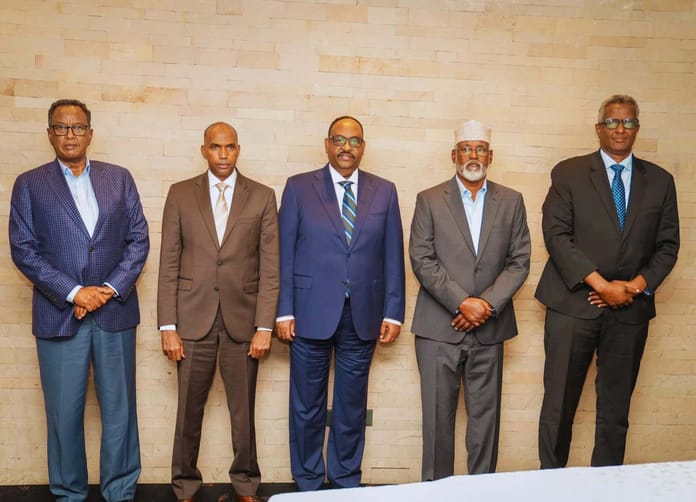
Kismayo (Somalia Today) — Somalia’s political crisis deepened significantly on Wednesday as the country’s leading opposition figures converged on the southern port city of Kismayo for a high-stakes summit, carrying with them a threat that could fracture the fragile federal republic.
As delegates gathered inside the fortified presidential palace of Jubaland State on December 17, the ultimatum issued just hours prior hung heavy over the proceedings: if President Hassan Sheikh Mohamud proceeds with an election plan they contend is a vehicle for an illegal term extension, the opposition will move to form a parallel government.
The warning, delivered by the newly formed “Council for the Future of Somalia,” marks the sharpest escalation yet in a standoff that has paralyzed the Horn of Africa nation for months.
“If the president, who has four months left in his term, continues this theatre, the second phase will be the formation of a government by the Council and the Somali people,” asserted Dahir Amin Jesow, a prominent opposition lawmaker, setting a combative tone before the talks even began.
Yet as rival heavyweights—including former president and three former prime ministers—meet under the protection of Jubaland President Ahmed Madobe, the summit has laid bare a glaring contradiction.
The opposition leaders present themselves as guardians of constitutional order, denouncing President Mohamud’s “unilateral” push for direct elections.
At the same time, they are doing so from a platform the regional strongman provides, even though his own mandate has long relied on the very tactics of exclusion and control they accuse the federal government of employing.
The ‘Jubaland paradox’
That contrast is not a footnote. It is the story defining this week’s events in Kismayo.
While the opposition decries the March 2024 constitutional amendments —which introduced direct presidential elections and expanded executive power to appoint the prime minister—as an authoritarian power grab, they continue to treat their host, Ahmed Madobe, as a beacon of legitimacy.
This selective application of democratic standards came into sharp relief just last year. In November 2024, Madobe secured a third term as Jubaland’s president in a contest that systematically narrowed the field of candidates.
A commission appointed by Madobe’s administration managed the process after he walked out of national consultative talks.
Madobe won 55 of the 75 votes cast by state lawmakers. Serious challengers could not mount a viable run, leaving Madobe to face only token opposition from candidates, such as Abukar Abdi Hassan and Faisal Omar Matan, who combined for 20 votes.
The Federal Government in Mogadishu immediately declared the process “unlawful” and “void,” issuing an arrest warrant for Madobe on charges of treason and endangering national unity.
Even so, the “Council for the Future of Somalia” has embraced Madobe’s re-election. By anchoring their national challenge in Kismayo, the opposition has forged an alliance built on selective legitimacy.
It condemns “authoritarianism” at the center while normalizing it at the periphery, so long as the periphery is controlled by an ally. As analysts note, the summit is not simply a protest against centralization.
It is a strategic alignment where “legality” functions as a tactical weapon rather than a consistent principle.
A familiar script of hypocrisy
Somalia has seen this film before. In 2021, the roles almost perfectly flipped.
Then-President Mohamed Abdullahi Mohamed “Farmaajo” backed a parliamentary move to extend his mandate by two years, arguing that the extra time was necessary to implement “One Person, One Vote” (1P1V) elections—the exact same argument President Mohamud is deploying today.
During that crisis, Hassan Sheikh Mohamud—then the firebrand leader of the opposition “Council of Presidential Candidates”—warned that the push for universal suffrage was an “impossible mandate” designed to justify an indefinite stay in power.
He argued that the security infrastructure did not exist for a credible census or voter registration.
Today, sitting in Villa Somalia, President Mohamud has adopted the 1P1V agenda as “non-negotiable.” He claims it is the only way to move the nation past the “corrupt” clan-based 4.5 power-sharing formula.
The hypocrisy is equally stark on the other side of the table in Kismayo.
Former Prime Minister Hassan Ali Khaire, now a leading voice in the Council for the Future of Somalia, once led the federal government’s campaign to delegitimize Madobe during his contested re-election in 2019.
At that time, Khaire’s administration refused to recognize Madobe’s victory. It backed rival candidates in parallel processes and imposed a flight ban on Kismayo to prevent opposition figures—including current ally Sheikh Sharif Sheikh Ahmed—from attending the inauguration.
Today, the details differ, but the structure rhymes. An incumbent frames reforms as necessary to complete a democratic transition; rivals frame the same reforms as a coup.
Each side claims the constitution; each side warns of national collapse. The deeper continuity is not ideological, but transactional.
The Kismayo summit reveals a political marketplace where alliances shift based on who holds the keys to the presidential palace, creating a cycle of outrage without principle.
The ‘one vote’ trap
The core of the dispute lies in the transition from the “4.5” clan system to universal suffrage. While 1P1V is a widely held aspiration across Somalia and is backed by international partners, the opposition views it as a political trap.
To supporters of the president, the promise of direct elections is a legitimizing mission—a claim to be building a state around citizens rather than factions.
The government points to the passage of the National Electoral Law and the Political Parties Law in November 2024 as evidence of its commitment.
However, credible direct elections require practical foundations that Somalia currently lacks. These include secure polling access beyond the capital, a biometric voter registry, and agreed electoral boundaries.
Opposition leaders argue that pushing for such a complex exercise within the remaining four months of the president’s term is mathematically impossible.
They contend that leaders are deploying the “1P1V” project to justify a delay, creating a “constitutional vacuum” that will necessitate a term extension.
This dynamic creates a perverse incentive structure. Because the federal level has more veto points and greater external scrutiny, it is harder for a single actor to monopolise than in a regional administration.
Regional leaders like Madobe can more easily narrow the electoral field, define eligibility, and police political space through local security structures—projecting the appearance of competition while controlling the outcome.
By contrast, when the federal process breaks down, it becomes an international crisis, raising Mogadishu’s reputational costs.
The security cost to citizens
While the elite bargain over constitutional interpretations in Kismayo, ordinary citizens pay the cost of the deadlock. The most damaging feature of this cycle is that the argument repeatedly crowds out governance.
The breakdown in relations between the Federal Government and Jubaland has severed critical security cooperation.
With the arrest warrant for Madobe active, intelligence sharing and joint operations between the Somali National Army (SNA) and Jubaland forces have effectively ceased in the Juba Valley.
This security vacuum offers a lifeline to Al-Shabaab, the Al-Qaeda-linked insurgency that thrives on the distraction of the political class.
The consequences came into grim view just days before the summit convened, when a suicide bomber targeted a key military academy in Mogadishu, even though the government said security forces thwarted and repelled the attack. It was one of many recent security lapses in the capital and across the country.
The opposition was quick to accuse President Mohamud of “abandoning” the war on terror to pursue “divisive political agendas.”
Yet by threatening a parallel government and deepening the rift, the opposition risks further fragmenting the security forces. It could also split the military along clan lines, as happened during the 2021 crisis.
The donor dilemma
International partners, who fund much of Somalia’s security and state-building budget, find themselves in a bind.
They rarely want to be seen opposing democratic language—especially a pledge to move to universal suffrage. As a result, a president who frames himself as delivering democracy can secure international patience, even when timelines are unrealistic.
In that context, the “parallel government” ultimatum from Kismayo sends a message to foreign capitals as much as to domestic consumption. It signals that the crisis will not be contained within Mogadishu’s institutions and that forcing a consensus will require external pressure.
As the summit runs through December 20, the speeches will likely grow sharper and the threats more absolute. But the core problem is not a shortage of constitutional vocabulary. It is the absence of principle behind it.
Somalia’s political class has turned “democracy” into a rented suit, worn when it helps and discarded when it constrains. The same leaders who denounce term extension in Mogadishu bless indefinite rule in the regions.
Until Somalia’s leaders accept a basic discipline—that constitutional order must apply to friends and foes alike—every election debate will remain a power struggle disguised as reform. Legitimacy will continue to operate like a light switch: on for allies, off for rivals, and always controlled by whoever benefits in the moment.
The Kismayo gathering, then, is not only a challenge to President Hassan Sheikh. It is a mirror held up to Somalia’s politics itself: a system where outrage substitutes for standards, alliances substitute for law, and “national rescue” becomes the permanent justification for the next round of hypocrisy.
Disclaimer: The views and opinions expressed in this article are those of the author and do not necessarily reflect the official policy or position of Somalia Today.


