
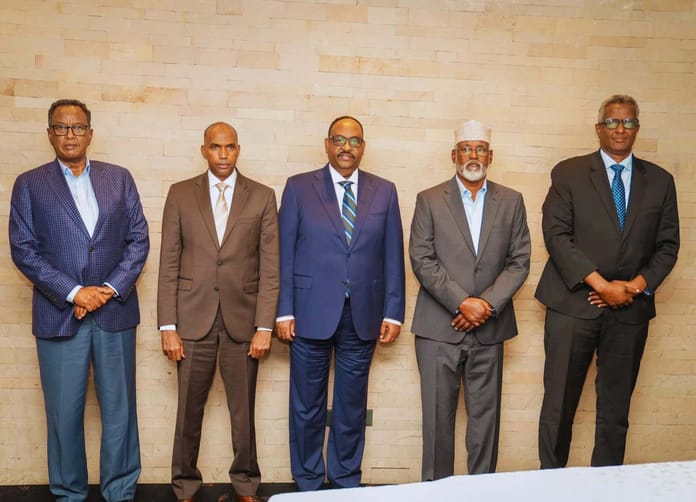
Mogadishu (Somalia Today) — Somalia’s leading opposition figures have issued an ultimatum to form a parallel government if President Hassan Sheikh Mohamud proceeds with a disputed election plan they contend is a vehicle for an illegal term extension.
The warning comes as key rivals gather in the southern port city of Kismayo for a high-stakes summit on Wednesday, exacerbating a constitutional standoff that threatens to fracture the country’s fragile federal system.
Members of the Council for the Future of Somalia announced they would grant the president one final opportunity to reverse course. Should he refuse, they vowed to take “decisive” action to establish an alternative administration.
“If the president, who has four months left in his term, continues this theatre, the second phase will be the formation of a government by the Council and the Somali people,” asserted Dahir Amin Jesow, a prominent opposition lawmaker.
“However, the first phase is to hold a conference for the Council and the nation.”
Battle over universal suffrage
The dispute centres on the federal government’s aggressive push to implement universal suffrage—a direct “one-person, one-vote” system—to replace the country’s traditional clan-based indirect model.
President Mohamud has anchored his administration’s legacy on delivering this transition. He relies on a series of controversial constitutional amendments passed by parliament in March 2024.
Those amendments introduced direct presidential elections, extended the presidential term from four to five years, and granted the president the power to appoint the prime minister without parliamentary approval.
The government argues these structural changes are essential to enfranchise Somali citizens and move the nation past the exclusionary “4.5” clan power-sharing formula.
However, opposition leaders and federal member states like Puntland and Jubbaland reject the amendments.
They argue the administration pushed the changes through unilaterally, without broad consensus. Critics maintain the package undercuts the federal power-sharing arrangement and concentrates authority in the presidency.
Jesow dismissed the government’s registered political parties—a key requirement of the new universal suffrage laws—as “puppets” controlled by the presidential palace to rig the outcome.
“There is nowhere for them to go. The JSP party he talks about is just Hassan 1, Hassan 2, and Hassan 3,” Jesow said. “We cannot accept a four-month term-end and the formation of a local council in Benadir. It will not work.”
Rivals gather in Kismaayo
The warning sets a tense stage for the Kismayo conference. Jubbaland President Ahmed Madobe, a fierce critic of the federal government’s electoral roadmap, hosts the event.
The first delegation, led by Mohamed Aden Kofi of the National Salvation Forum arrived in the city on Tuesday. Jubbaland Interior Minister Mohamed Ibrahim Oogle received them at the airport.
“This meeting addresses a critical and complex political situation,” Kofi told reporters at Sayid Mohamed Abdulle Hassan Airport. “We will discuss issues vital to the rescue of the nation.”
The four-day summit, scheduled to run from December 17 to 20, brings together the country’s most powerful opposition figures. Attendees include former President Sheikh Sharif Sheikh Ahmed and former Prime Minister Hassan Ali Khaire.
Organizers say the gathering will finalize the structure of the “Council for the Future of Somalia,” a new umbrella bloc that aims to challenge the federal government’s authority directly.
Accusations of ‘term extension’
Opposition leaders argue the government’s timeline for universal suffrage is mathematically impossible to achieve before the current term expires. They view the plan as a pretext for an unconstitutional extension.
Former President Sheikh Sharif Sheikh Ahmed warned that the current parliament lacks legal grounds to extend its stay.
“The current parliament cannot extend its own term,” Sharif declared in Mogadishu before departing for the summit. “If it ends correctly, the next parliament takes over. Their four years have ended in conflict, displacement, and asset stripping.”
Former Prime Minister Hassan Ali Khaire echoed these concerns. He accused the administration of creating a “constitutional vacuum.”
“One-person, one-vote is a national aspiration that requires preparation,” Khaire noted. “But the leaders have turned it into a tactic for a term extension that will not be accepted.”
Khaire recently issued a statement condemning what he called the “coercive” voter registration process in Mogadishu. He warned it risks sparking civil unrest.
Constitutional breakdown
The standoff has paralyzed cooperation between the federal government in Mogadishu and key regional states.
Jubbaland and Puntland have effectively suspended ties with the capital. They rejected the March 2024 amendments as illegal and withdrew recognition of the federal government until a nationwide referendum validates the changes.
Meanwhile, the opposition’s new coalition has called for a return to the 2012 provisional constitution. They advocate for a consensus-based electoral model to avoid violence.
Security in Kismaayo has tightened ahead of the talks, with Jubbaland forces deploying across the city.
In a statement, the Council for the Future of Somalia urged the public to prepare for a “national rescue” effort.
“The Council declares it is firmly opposed to any step leading to a term extension by federal institutions,” the group stated. “Any result from an election without agreement… is null and void.”


