
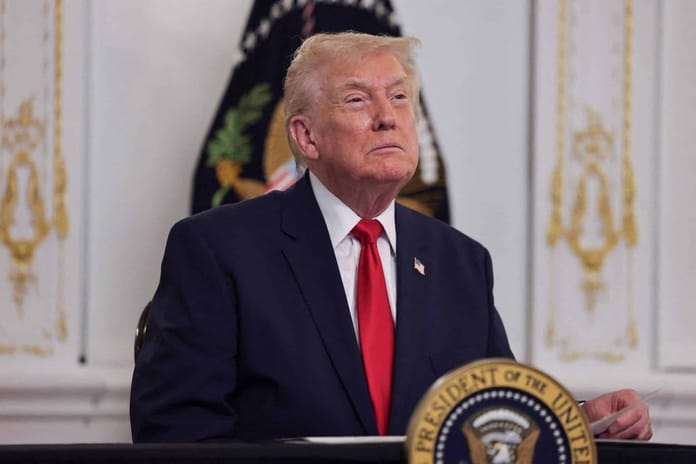
West Palm Beach (Somalia Today) — President Donald Trump says he will “permanently pause” migration from Somalia and what he calls “Third World countries,” sharpening a drive to push out millions of immigrants who are already in the United States.
His latest threat came in a fiery Thanksgiving message on his Truth Social platform, where he demanded “REVERSE MIGRATION,” blamed immigrants for crime and housing shortages, and vowed to strip benefits and even citizenship from people he deems “non-compatible with Western civilization.”
Trump, who returned to the Oval Office in January, is tying the crackdown to the shooting of two National Guard members near the White House, even though he did not mention the attack in his post. One of the soldiers has died; the other remains in critical condition.
Somalis, Minnesota, in the crosshairs
In the same message, Trump singled out Somali refugees in Minnesota.
He claimed they were “completely taking over” the state and described “Somalian gangs” as “roving the streets looking for prey,” language that drew immediate outrage from community leaders and civil rights groups.
The president also used a slur for people with intellectual disabilities to insult Minnesota Governor Tim Walz, and revived old, unsupported claims about Democratic Congresswoman Ilhan Omar’s immigration history.
Critics accused him of demeaning an entire community and stoking fear.
Minnesota is home to the largest Somali community in the United States. Estimates put the Somali-born population in the tens of thousands, a little over 1 percent of the state’s residents, far short of the “hundreds of thousands” Trump described.
Local lawmakers, faith leaders, and Somali activists have held rallies and news conferences in response. They warn that Trump’s rhetoric will fuel harassment and make Somali Americans feel less safe in schools, workplaces, and on the streets.
Community figures also stress that Somali workers are deeply woven into Minnesota’s economy, from home health care and food plants to taxis, small groceries, and restaurants.
Many now hold city council and state legislative seats, a visibility they say is at odds with Trump’s portrayal of a community driving “social dysfunction.”
Guard shooting as trigger
Trump’s escalation follows the shooting of two West Virginia National Guard members who were patrolling near the White House under his orders.
Specialist Sarah Beckstrom, 20, died on Thursday. Staff Sgt. Andrew Wolfe, 24, is still in critical condition.
Prosecutors have charged Rahmanullah Lakanwal, a 29-year-old Afghan national who once worked with a CIA-backed unit during the Afghanistan war. He later entered the United States under a resettlement programme for Afghans who helped U.S. forces.
Authorities say Lakanwal drove across the country to Washington, D.C., and opened fire on the Guard vehicle. Police also shot him, leaving him with non-life-threatening wounds.
Asked by reporters if he blamed all Afghans for the attack, Trump replied: “No, but we’ve had a lot of problems with Afghans.”
Even before the shooting, his administration had spent months tightening rules on migrants from a list of “countries of concern.” The incident has given the White House a new justification to push further.
Travel bans and ‘Third World’ list
In recent days, Trump has ordered officials to re-examine millions of immigration files.
He wants a fresh review of green cards and other documents issued to people from 19 states his administration treats as “high-risk,” a group that includes Somalia and Afghanistan.
U.S. Citizenship and Immigration Services (USCIS) has issued new guidance telling officers to treat “country-specific factors” as major grounds for denying visas, permanent residence, and other benefits to applicants from those countries, according to a recent USCIS notice.
Officials have not published a public list of “Third World” countries. The Department of Homeland Security instead points to a June presidential proclamation that already suspends or sharply restricts entry from 19 nations, many of them in Africa and the wider Muslim world.
That order expanded earlier travel bans and drew criticism from rights groups.
Advocates say Somalia is now among the countries where new visa processing has effectively frozen. Green-card holders from those states say they were told their status will be rechecked under the new security rules.
The United Nations human rights office and refugee agency have urged Washington to avoid sweeping measures that punish entire nationalities.
They warn that collective bans, triggered by a single crime, risk breaching refugee law and longstanding human rights standards.
Crime claims clash with evidence
Trump’s Thanksgiving post claimed that “most” foreign-born U.S. residents are “on welfare, from failed nations, or from prisons, mental institutions, gangs, or drug cartels.” He linked them to what he called a wave of “social dysfunction” from crime to failing schools.
Research tells a different story. Studies across U.S. cities have repeatedly found that neighbourhoods with more immigrants do not see higher crime rates, and in many cases see less violence than areas with fewer foreign-born residents.
One recent criminology review of academic work on immigration and crime concluded that the perception that migrants fuel crime “falters under the weight of the evidence.”
Another long-term incarceration study using 150 years of census data found that immigrants have had lower incarceration rates than U.S.-born residents for a century and a half, and are now about 60 percent less likely to be imprisoned.
Economists also note that foreign-born workers fill about 31 million jobs in the United States, roughly a fifth of the workforce. They cover everything from agriculture and construction to health care, hospitality, and logistics, according to a recent labor-force brief.
Business groups in Minnesota say that it is plain to see in their state. Somali and other immigrant staff work in factories, drive delivery trucks, run convenience stores, and provide home-care services in a rapidly ageing population.
Employers warn that mass deportations and a freeze on new arrivals would deepen existing labour shortages.
Somali fears at home and abroad
Trump’s threat to halt migration from Somalia is being felt far beyond Minnesota.
The Somali diaspora in the United States, Europe, and the Gulf sends hundreds of millions of dollars home each year.
Families in Mogadishu and across Somalia use that money to buy food, pay school fees, and cover hospital bills, according to long-running remittance studies.
Somali-American advocates say tighter U.S. rules on family reunification and refugee resettlement would choke off one of the main safe routes out of conflict-hit areas.
They fear more young people will turn to irregular journeys through Africa and across the Mediterranean.
Community leaders also worry about the echo back home. Trump’s words travel quickly on Somali-language social media.
Activists say painting Somali refugees as criminals will harden attitudes toward returnees and make it harder for them to invest in businesses or social projects when they go back.
What happens next
Trump has not yet published detailed legal texts to explain how a permanent “pause” on migration from Somalia and other targeted states would work.
It remains unclear how far he will go in cancelling existing visas, green cards, and even naturalised citizenships.
Civil rights groups and immigration lawyers are preparing challenges. They argue that blanket nationality-based bans and attempts to strip citizenship from people who have not been convicted of crimes will collide with the U.S. Constitution and longstanding immigration law.
Court battles are almost certain if the administration turns social-media pledges into formal orders.
For Somali families in Minnesota, and relatives waiting in refugee camps in East Africa, the uncertainty is already taking a toll.
Advocates say Trump’s words alone are enough to spread fear — from the streets of Minneapolis to the neighbourhoods of Mogadishu — even before any new decree is signed.


