
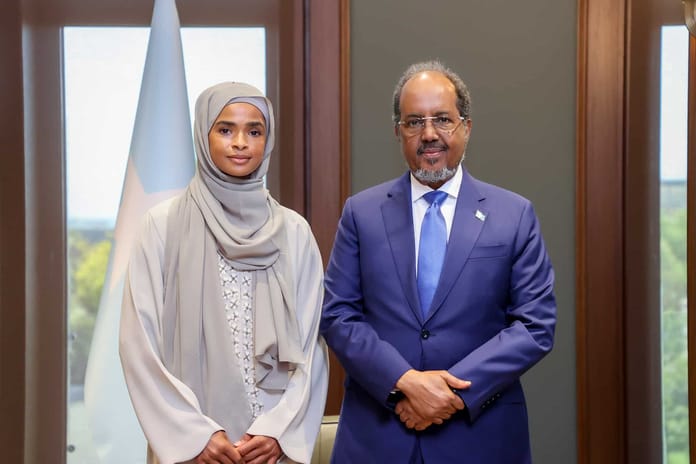
London (Somalia Today) — Ramla Ali says a long-awaited visit to Somalia has cost her a coveted place on a Netflix boxing card in the United States, blaming a US visa denial and a broken promise of a Somali diplomatic passport for losing the bout.
In a TikTok video to her followers, the Somali-British boxer says promoters dropped her from the December 19 show in Miami after US authorities denied her a visa.
She links that refusal directly to her recent trip to Mogadishu and to a pledge she says Somali officials made to issue her a diplomatic passport.
Ali had been due to fight on the undercard of the “Judgment Day” event at Miami’s Kaseya Center.
The headline bout will pit YouTuber-turned-boxer Jake Paul against former heavyweight champion Anthony Joshua in an eight-round contest that Netflix plans to show live.
The card marks one of the platform’s biggest moves yet into live boxing, with Paul’s company, Most Valuable Promotions, running the event.
“Because of my recent visit to Somalia, and because I still haven’t received the diplomatic passport I was promised, I can’t go to America for the fight,” Ali says in Somali in the clip.
“The president, the ministers, they all promised me. I am still waiting. Nothing has arrived, and now I cannot make the December 19 bout.”
Her manager appears in the same video. He tells her he must remove her from the card because he has “no guarantee” from the US side and urges her to “do everything you can” so future events do not slip away the same way.
Somalia visit
Ali says the promise came during a highly publicised homecoming in September, when she travelled to Mogadishu for the first time in more than 30 years.
During that trip, she met President Hassan Sheikh Mohamud at Villa Somalia and held talks with ministers who hailed her as a symbol of Somali success abroad.
Now, in her TikTok message, she turns back to those same leaders. She calls on the president, the youth and sports minister, and other senior officials to honour what she describes as a clear pledge to give her a Somali diplomatic passport that would ease travel to major tournaments.
“I just wanted to see my country and my people,” she tells followers. “Now, as a Somali, I feel heartbroken.”
Somalia’s youth and sports minister, Mohamed Cabduqaadir Gurey, firmly disputes her account. Speaking to the BBC Somali service, he says no one in government promised Ali a diplomatic passport.
He confirms that Ali visited Mogadishu and asked for help with travel documents. He says his ministry supported an application for a service passport, a document typically used by public servants and athletes, and submitted the request while she was in the capital.
“We did what we could within our mandate,” Gurey says. He stresses that diplomatic passports go to diplomats and “those the president personally designates.”
The minister also says the government is unaware of any current competition in which Ali officially represents the Somali state.
“She is a Somali athlete, and we recognise that,” he says. “But there is no event we are part of now where she competes on behalf of the government.”
Passport politics
The row comes at a sensitive moment for Somalia’s travel documents. Only days earlier, Germany moved to grant full recognition to Somalia’s diplomatic passport, a decision Somali officials hailed as a breakthrough after years of scepticism in parts of Europe.
Somalia Today covered Berlin’s move in a separate report, Germany grants full status to Somalia’s diplomatic passport.
For Ali, the timing feels harsh. While Mogadishu celebrates a newfound respect for its diplomatic passport, she says she still waits for the document that, in her telling, officials promised her and watches a career-shaping appearance on a Netflix card slip away.
Her case has revived a familiar debate among Somalis at home and abroad. Critics say access to different passport types – ordinary, service, and diplomatic – can be uneven and often depends on connections.
They argue that star athletes and artists still struggle to get consistent consular support. Officials respond that Somalia must guard the credibility of its diplomatic passports as it rebuilds institutions after decades of war and document fraud.
Ramla Ali’s rise
Ali’s anger comes at the height of an unusual career. Born in Mogadishu and raised in Britain after her family fled the civil war, she became the first boxer ever to represent Somalia at the Olympic Games when she fought at Tokyo 2020.
In 2017, she also became the first Muslim woman to win an English national boxing title.
Since then, she has mixed a professional career with advocacy for refugees and women in sport. She co-founded a charity boxing club for women from marginalised communities and has received international honours, including a spot on TIME’s 2023 Women of the Year list.
Her deal with Jake Paul’s Most Valuable Promotions now aims to anchor the next phase of her career, putting her on big US shows and live Netflix events. A slot on the Paul–Joshua bill would have deepened that momentum.
Ali has not revealed the detailed reasoning given by US authorities when they denied her visa, and Washington has not commented on the case. Officials have not suggested that she faces a permanent ban.
Even so, her claim that a visit to Somalia helped derail her travel fits into a wider picture.
US visa rules
Under the Visa Waiver Program, nationals of countries such as Britain who have travelled to Somalia since 2011 can no longer use the fast-track ESTA system. They must instead apply for a full visa, a process that can involve extra checks and take longer.
Immigration lawyers say these rules do not automatically block people from entering the United States.
However, they do add delays and uncertainty, especially when applications arrive close to event dates or involve complex travel histories. For an athlete working to fixed fight nights and broadcast slots, those delays can be costly.
For Ali, the immediate outcome is simple: she will not fight on the December 19 card in Miami. Promoters still plan to stage the Paul–Joshua main event and the rest of the show at the Kaseya Center, with Netflix streaming the card live.
Meanwhile, Somalis have taken to social media to argue over what her case says about the state’s relationship with its diaspora stars.
Some say the presidency and the sports ministry should move quickly to repair ties with Ali and spell out their passport policy for high-profile athletes. Others defend the government’s stance and warn against treating diplomatic passports as routine perks for celebrities.
Ali says she still loves Somalia but feels let down. “When I left Somalia, the promise they made to me vanished,” she says in the video, her face tight with disappointment. “Right now, as a Somali, I feel my heart has broken.”


