
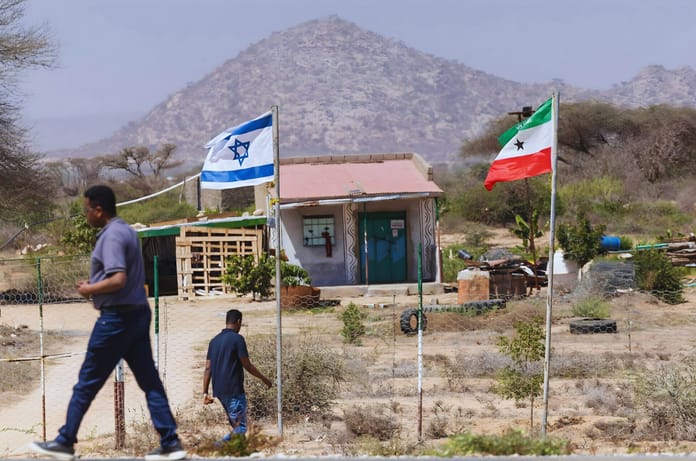
Mogadishu (Somalia Today) — Somalia warned on Thursday that no part of its territory could serve as a springboard for foreign military operations, after reports that Israel is considering a base in the breakaway Somaliland region in Somalia.
Ali Omar, Somalia’s state minister for foreign affairs, said Mogadishu did not want Somali territory to be “pulled into external confrontations” or used in ways that could further destabilise an already fragile region.
The warning followed reports this week by Bloomberg and Sweden’s public radio Ekot that Israel was exploring a military installation near the strategic port city of Berbera on the Gulf of Aden, directly opposite Yemen.
Omar said only Somalia’s federal government has the authority to enter into international security or military arrangements on behalf of the country.
“Any discussions about foreign military facilities on Somali territory that take place outside that framework simply have no legal standing,” he told Al Jazeera.
The reports surfaced as the U.S.-Israeli war on Iran entered its second week, with maritime routes across the Gulf and Red Sea facing fresh disruption and Yemen’s Houthis.
In comments reported by Bloomberg, Somaliland’s presidency minister, Khadar Hussein Abdi, said Somaliland would pursue a “strategic relationship” with Israel that “encompasses a lot of things”.
He said the possibility of an Israeli base had not yet come up, but added that “they will analyse it at some point”.
Strategic coastline
The issue has gained added significance because Berbera sits along one of the world’s most sensitive maritime corridors.
The port lies near the Bab al-Mandeb Strait, the narrow waterway linking the Red Sea to the Gulf of Aden and the Indian Ocean, through which a significant share of global trade passes.
Any foreign military presence there would immediately attract scrutiny from regional powers, shipping firms, and armed groups operating across the Red Sea basin.
Somaliland declared independence from Somalia in 1991, but for more than three decades did not secure recognition from any United Nations member state.
That changed on December 26, when Israel became the first country to recognise Somaliland as an independent state, triggering a furious response from Mogadishu and criticism from across the region.
Somalia continues to regard Somaliland as part of its sovereign territory, even though the region has governed itself separately for more than 30 years.
Since recognition, Somaliland officials have sent mixed signals about the scope of their new ties with Israel.
In January, Somaliland’s foreign ministry denied that any military arrangements were under discussion and said its engagement with Israel was “purely diplomatic”.
But shortly afterwards, an official told Israeli media that a base was “on the table and being discussed”.
In February, Khadar Hussein Abdi told AFP he could not rule out allowing Israel to establish a military presence in Somaliland.
Those remarks deepened suspicions in Mogadishu, which sees any separate security agreement involving Somaliland as a direct challenge to Somali sovereignty.
Wider war fears
The dispute comes amid rising regional tensions as the conflict involving Israel, the United States, and Iran spreads across key waterways and strategic chokepoints.
The Strait of Hormuz, through which about a fifth of the world’s oil and gas supplies transit, has seen severe disruption amid Iranian threats against shipping.
Attention has also turned to the Bab al-Mandeb, where Houthi attacks and threats have already shaken commercial traffic over the past year.
The Iran-aligned Yemeni rebels have previously warned that they would see any Israeli presence in Somaliland as a hostile move and a legitimate target.
That warning now carries greater weight as the Houthis signal they may enter the current conflict more directly.
For Somalia, the prospect of a foreign military base in Somaliland raises the risk that its coastline could become entangled in a conflict far beyond its borders.
“The Red Sea and the Gulf of Aden are critical corridors for global trade and regional security, and instability there affects the entire Horn of Africa,” Omar told Al Jazeera.
“When regional tensions rise, civilian populations are always the most vulnerable,” he said, adding that steps that could expose Somali communities to unnecessary risks or draw them into wider geopolitical conflict were not in the interest of the Somali people.
New security warnings in neighbouring Djibouti, home to Camp Lemonnier, the main U.S. military base in Africa, have also heightened regional concern.
The U.S. embassy there this week advised Americans to avoid the area around the embassy and the base because of ongoing regional tensions and public threats against U.S. interests.
Sovereignty dispute
For Mogadishu, the reports about Berbera revive a broader concern that Somaliland’s coastline is increasingly becoming a platform for outside powers competing for influence around the Red Sea.
That anxiety was already on display in 2024, when Ethiopia signed a memorandum of understanding for sea access in Somaliland, triggering a major diplomatic crisis with Somalia before Turkish mediation helped ease tensions.
Somali officials now fear that a possible Israeli military foothold would add another volatile dimension to an already complex contest over ports, shipping lanes, and regional alliances.
Somalia’s position remains that no foreign military arrangement on its territory is valid unless the federal government approves it.
But with Israel now formally recognising Somaliland, Houthi threats already on record, and the Middle East war widening, officials in Mogadishu appear increasingly concerned that the Horn of Africa could become the next arena for a conflict unfolding across the Gulf and the Red Sea.


