

London (Somalia Today) — The man widely reported as a new global leader of the Islamic State is holed up in remote caves in northern Somalia, while his estranged British wife and three children live quietly in the English town of Slough, according to UK Media reports.
Abdul Qadir Mumin is a Somali-born preacher who once held a British passport and preached in London and Leicester. Western governments have for years identified him as the figurehead of the Islamic State’s Somalia branch.
The US Treasury has listed him as a “Specially Designated Global Terrorist” under counter-terrorism sanctions since 2016.
Life in Slough
Thousands of kilometres from his hideout in Puntland’s Cal Miskaad mountains, a very different life unfolds in Berkshire.
UK media say Mumin’s wife, 43-year-old British-Somali citizen Muna Abdule, lives in a two-bedroom council flat in Slough with their son, 20, and two daughters, aged 18 and 17.
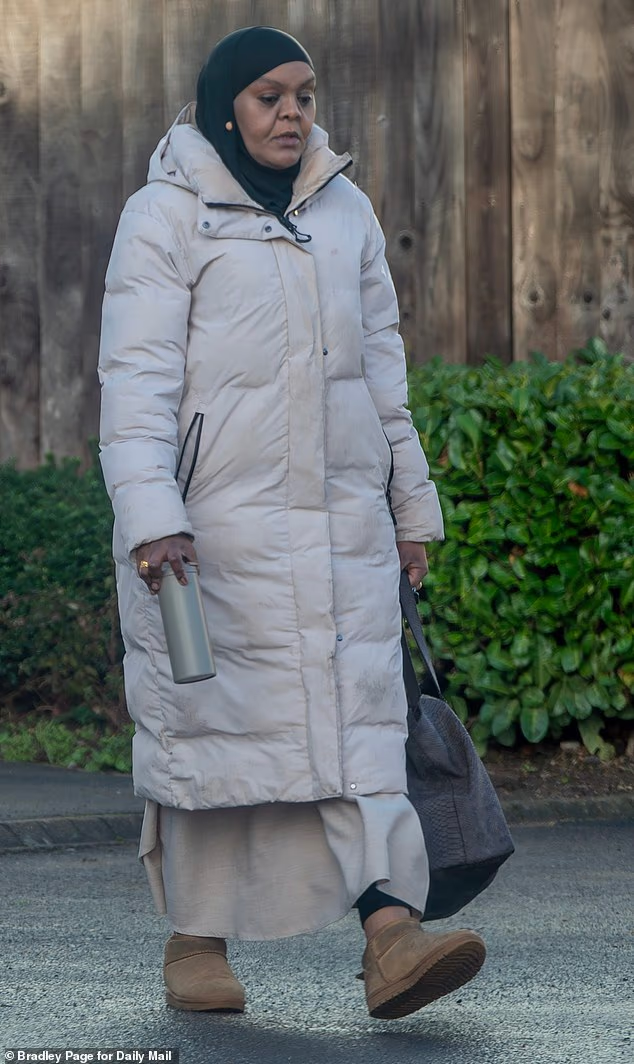
Abdule works for a local health company. She has raised three children on her own since her husband left the UK around 2010 without telling the family where he was going.
She told reporters that he “abandoned” them and that they have had no contact for more than a decade.
Friends quoted in the same reports say the children know who their father is but want nothing to do with him.
They portray the family as trying to live an ordinary life despite his notoriety, and say Abdule has focused on work and school routines to keep the household stable.
There is no public indication that Abdule or her children are suspected of any offence. Reporting so far presents them as relatives left behind by a man who chose jihad over family, rather than as collaborators in his activities.
Gothenburg to Greenwich
Mumin’s journey to Puntland runs through the immigrant suburbs of Gothenburg and the mosques of southeast London.
He left Somalia during the civil war and settled in Sweden in the early 1990s. He lived in the Hjällbo district of Gothenburg and preached at the Bellevue Mosque, which later drew attention from researchers and security services for radical activity.
Swedish media later caught him on hidden camera making comments in favour of female genital mutilation for his own daughter. The reports prompted an investigation and helped push him out of the country.
He moved to Britain around 2003, first to Leicester and then to Greenwich in southeast London, where he obtained British citizenship and became a familiar figure in local Somali cafés and prayer halls.
It was in this period that he married Abdule, who comes from the same Ali Salebaan sub-clan. The pair wed in a traditional ceremony in Leicester when she was 19, and he was already in his late forties. They later moved to London, where all three of their children were born.
In Greenwich, Mumin preached at the local mosque and, according to British reporting, tried to draw young Somali men into jihadist circles.
Two of the people who passed through the same environment — Mohammed Emwazi, later known as “Jihadi John”, and Michael Adebolajo, one of the killers of Fusilier Lee Rigby — would go on to become among Britain’s most infamous extremists.
Preacher to commander
Facing increased scrutiny from security services, Mumin left the UK around 2010 and resurfaced in Somalia.
Reports say he spent time in Kenya before crossing into Puntland, where he joined the al-Qaeda-linked group al-Shabaab and publicly burned his British passport in front of supporters.
He later broke with al-Shabaab leadership. In October 2015, in an audio message from the Puntland hills, he pledged allegiance to the Islamic State’s then leader in Iraq and Syria.
That declaration created what became known as the Islamic State in Somalia and placed Mumin at the head of a new “province” on the group’s map.
Within a year, his fighters briefly captured the coastal town of Qandala in Puntland before regional forces pushed them back into the surrounding mountains, according to UN monitoring.
The episode showed that even a small ISIS cell in Somalia was willing to test holding territory, not just staging raids.
Biographical profiles, including an open-source entry, say he has married several times and has wives in both Europe and Somalia. One of them, Fartun Abdirashid Hussein, faced a military court in Mogadishu and received an eight-year sentence on charges of ISIS membership and financing.
Somalia ISIS hub
Although estimates often put ISIS-Somalia’s core force in the low hundreds, Western governments and researchers now describe it as one of the group’s most important remaining hubs.
The US Treasury says a Somalia-based unit known as the Al-Karrar office manages money and support for other ISIS branches across Africa.
A 2023 Treasury press release on a senior ISIS-Somalia financier said the group generated “nearly $2 million” in the first half of 2022 alone.
The money came from extorting local businesses, imports, livestock, and agriculture. It then moved through cash couriers, hawalas and front companies.
A detailed CTC Sentinel analysis by the Combating Terrorism Center at West Point in September 2024 described ISIS-Somalia as a “growing global terror concern”.
It said Al-Karrar functions as a financial and operational hub that helps sustain ISIS cells from the eastern Democratic Republic of Congo to Mozambique and beyond.
Another CTC study, examining a May 2024 US airstrike, cited US officials as saying that Mumin had been targeted as a “global leader” of ISIS in that operation.
Public statements from the US military did not name him, and the article noted that his death remained unconfirmed.
Analysts quoted in those pieces argue that, regardless of job title, Mumin now sits at the centre of a Somalia-based structure that moves money and instructions around ISIS’s African network. The group still names an Iraq- or Syria-based figure as the overall caliph.
Puntland offensive
On the ground, Puntland and federal Somali forces, backed by US intelligence and air power, have stepped up operations against ISIS-Somalia positions in the Cal Miskaad range over the past year.
Africa Command has issued a series of notices on airstrikes targeting ISIS-Somalia since May 2024, with the latest one coming earlier this month.
Regional authorities have also launched ground offensives aimed at clearing cave networks, arms depots and checkpoints that feed the group’s extortion system along key roads.
Somali officials say they have killed foreign fighters and mid-level commanders in recent raids, but acknowledge that Mumin himself has repeatedly escaped.
Officers in Puntland’s counter-terrorism units have openly framed their campaign around him.
One commander told reporters that the day they kill Mumin will be “the happiest day” of his life, reflecting how much weight Somali security forces place on removing him from the battlefield.
Family distances itself
For British authorities, the renewed focus on Mumin’s role in ISIS-Somalia revives older questions about radicalisation in the UK.
His path from small mosques in Leicester and Greenwich to the leadership of a transnational jihadist network will likely feature in future reviews of counter-terrorism policy.
For Abdule and her children, the stakes are more immediate. Friends say she has spent years answering difficult questions from her children as they grew old enough to read about their father online, while trying to keep him out of their daily lives.
She says she does not follow news about his rise inside ISIS and that her family has “nothing to do with him”.
The picture painted by those who know her is of a woman who has chosen to build a separate life — school, work and rent in Slough — while the man she once married is hunted in the mountains of northern Somalia.


