
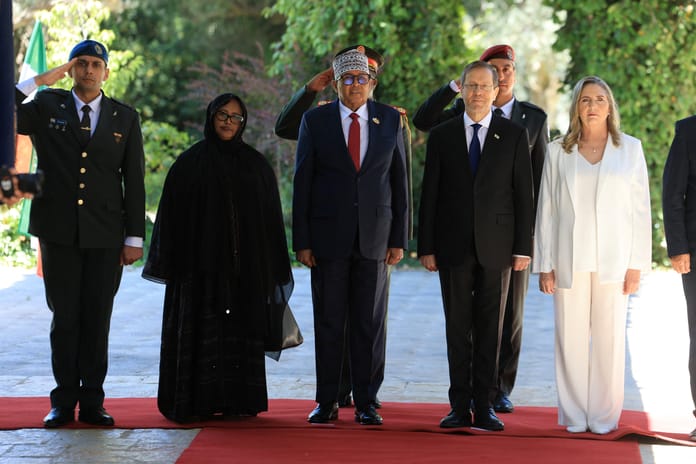
Jerusalem (Somalia Today) — Somaliland President Abdirahman Mohamed Abdullahi arrived in Israel on Sunday for the first visit by a leader of the breakaway region in northwestern Somalia.
Israel formally recognised Somaliland as an independent state in December, becoming the only United Nations member state to do so and drawing strong condemnation from Somalia and several international and regional bodies.
Somalia considers Somaliland part of its sovereign territory and says no foreign government can alter the country’s internationally recognised borders.
Abdullahi, widely known as Irro, received a formal welcome in Jerusalem from Israeli President Isaac Herzog, in a ceremony Israeli officials presented as a landmark moment in relations with Hargeisa.
“I have arrived in Israel as the first President of the Republic of Somaliland to undertake a state visit, and I am honoured by the warm welcome extended by my friend, President Isaac Herzog,” Abdullahi wrote on arrival.
“For thirty-five years, the people of Somaliland have built a peaceful, democratic and resilient nation. We asked the world: Do you see us? Israel answered first,” he said.
“Today marks a historic milestone in our journey and the beginning of a new chapter in the relationship between Somaliland and Israel.”
Herzog greeted him with a message in English and Somali: “Ku soo dhawow Israel” — welcome to Israel.
‘Courage and realism’
At the President’s Residence, Herzog praised what he called the “courage and realism” shown by both sides and said Israel now wanted to move the relationship beyond symbolism.
“The beautiful images of the people of Somaliland waving Israeli flags in celebration of this new relationship warmed all of our hearts,” Herzog said, referring to celebrations in Hargeisa after Israel’s recognition.
He said Somaliland’s separate administration had been “a reality on the ground for several decades” and called for practical cooperation in security, trade, technology and people-to-people ties.
“We both face the threat of radical extremism,” Herzog said.
“We both seek security and stability in the region and in the Horn of Africa. And we both see the importance of protecting maritime freedom.”
Israeli officials have framed the relationship as part of a broader security and economic partnership, while Somaliland officials hope that Israel’s recognition will encourage other states to follow suit.
Abdullahi thanked Israel for receiving him and said the visit carried personal and historical weight.
“We are deeply appreciative that the State of Israel has chosen to receive us with such honour on this historic occasion,” he said.
“By doing so, Israel has taken part in a moment that will be remembered in the diplomatic history of our nation, and we do not take that gesture lightly.”
He added: “Somaliland has been talking, has been reaching out to world leaders for the last 35 years. They were asking only one question: to see us. Only one country desired to see us and recognise Somaliland, and that’s the government of Israel and its people.”
Abdullahi also thanked Israeli Foreign Minister Gideon Sa’ar, who visited Hargeisa in January shortly after Israel’s recognition.
“You were the first to see us,” he said.
Jerusalem embassy
Abdullahi plans to open a Somaliland diplomatic mission in Jerusalem’s Malha Technology Park and address the Knesset on Tuesday evening, Israeli media reported.
Israeli reports said the mission would make Somaliland the eighth foreign entity to have a diplomatic presence in Jerusalem, after the United States, Guatemala, Honduras, Kosovo, Papua New Guinea, Paraguay, and Fiji opened embassies there.
The visit follows months of rapid diplomatic activity.
Israel and Hargeisa established formal ties in December; Sa’ar visited Hargeisa in January; Somaliland appointed Mohamed Hagi as its first ambassador to Israel in February; and Israel later appointed Michael Lotem as its non-resident ambassador to Somaliland.
But Mogadishu has rejected the entire process as an unlawful challenge to Somalia’s sovereignty.
President Hassan Sheikh Mohamud said in an interview published Saturday that Israel’s move did not amount to genuine recognition and would not change Somalia’s borders.
“Somaliland has not received recognition for more than 30 years, and it will not receive it now. This is not recognition. It is a trap,” Mohamud said.
He said Somalia had deliberately avoided confrontation with Somaliland and continued to favour dialogue.
“We have chosen dialogue and understanding, not force,” he said.
Somalia and Somaliland have held several rounds of talks over the years, but the process has repeatedly stalled over the core question of sovereignty.
Somaliland argues that its brief independence from Britain in 1960, before its union with Italian Somaliland, gives it a distinct legal claim.
Somalia rejects that argument, saying the 1960 union created a single, internationally recognised state whose territorial integrity remains non-negotiable.
‘Not negotiable’
Mohamud also said Israel had previously sought formal ties with Mogadishu, but Somalia declined.
“Israel approached us several times and wanted us to establish relations. We told them that the timing was not appropriate,” he said.
He linked Somalia’s position to Palestinian rights and warned against dragging the country into regional conflicts.
“Somalia will not be dragged into wars, political rivalries or strategic agendas that do not serve its national interest,” he said.
“The position of the federal government has not changed. Somalia’s unity and territorial integrity are not negotiable.”
Israel has denied claims that its recognition of Somaliland has links to any proposal involving Palestinians from Gaza or plans for military bases, saying the decision reflects diplomatic, economic and security interests.
But for Somalia, Abdullahi’s reception in Jerusalem marks the most visible challenge yet to Mogadishu’s sovereignty claim.
It also shows how the Somaliland dispute has moved from stalled Somali dialogue into the wider contest over the Red Sea, Gaza and the Horn of Africa.


