
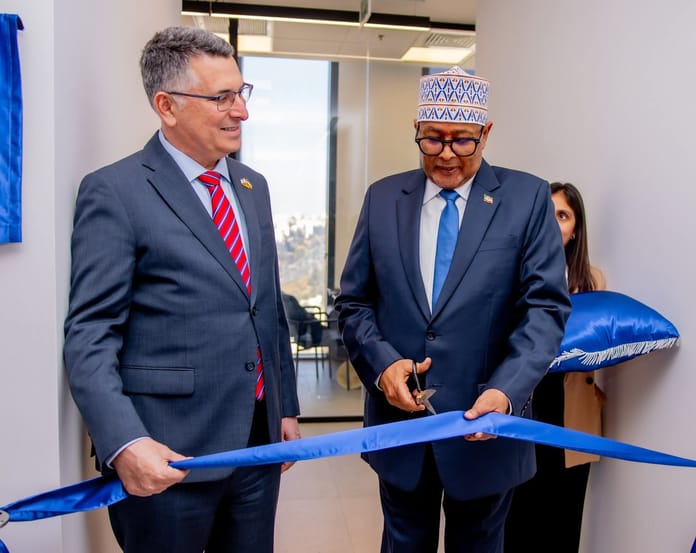
Jeddah (Somalia Today) — The Organisation of Islamic Cooperation (OIC) and the Palestinian Foreign Ministry condemned the opening of what Somaliland called an “embassy” in occupied Jerusalem on Monday, calling the move illegal and a violation of international law, Palestinian rights and Somalia’s sovereignty.
The condemnations came after Somaliland’s leader Abdirahman Mohamed Abdullahi, known as Irro, met Israeli Prime Minister Benjamin Netanyahu in Jerusalem and opened what the self-declared region in northwestern Somalia described as an embassy.
Somalia, which regards Somaliland as part of its territory, has rejected Israel’s recognition of Somaliland’s independence claim and denounced the Jerusalem move as a breach of its sovereignty and territorial integrity.
In a statement from Jeddah, the OIC said its General Secretariat “strongly condemned the opening of an embassy by the so-called ‘Somaliland’ in occupied Jerusalem”.
The 57-member bloc said the step was “illegal” and amounted to “a flagrant violation of the Charter of the United Nations and its relevant resolutions”.
The OIC said Israel, which it described as “the Occupying Power”, had “no sovereignty over Occupied Jerusalem”.
It also added that all decisions aimed at altering the city’s political, legal or demographic status remained “null and void under international law”.
The bloc also reaffirmed “its full solidarity with the Federal Republic of Somalia” and its support for Somalia’s “national sovereignty and territorial integrity”.
It called on the international community to take “a firm stance against this illegal move and to counter it”.
‘No legitimacy’
The Palestinian Foreign Ministry issued a separate statement under the headline: “No legitimacy for a so-called embassy in occupied Jerusalem.”
The ministry said it condemned “in the strongest terms” the opening of what it called a “purported embassy” by the so-called Somaliland authorities in the occupied city.
It described the move as “a blatant violation of international law and the relevant resolutions of international legitimacy”.
The ministry accused Israel and Somaliland authorities of trying to legitimise their presence “on land where they have no legal or political right”.
It said any diplomatic or political arrangements, or any attempt to change the status, position, geography or demography of Jerusalem, remained “invalid and void” and carried no legal effect.
The ministry said such steps could not alter Jerusalem’s internationally recognised legal status.
It also warned that any state or entity opening diplomatic missions in occupied Jerusalem violated UN Security Council resolutions, especially resolutions 476 and 478.
Those resolutions reject Israeli measures aimed at changing Jerusalem’s status and call on states not to establish diplomatic missions in the city.
The Palestinian ministry said the opening of missions in Jerusalem encouraged Israel’s “colonial and expansionist policies” and the daily crimes it said Israel commits against the Palestinian people.
Somalia’s unity
The Palestinian ministry also rejected Israel’s recognition of Somaliland’s independence claim.
It said it fully supported “the sovereignty of the sisterly Federal Republic of Somalia, its unity and territorial integrity”.
Somaliland declared independence from Somalia in 1991 after the collapse of the Somali state, but Mogadishu continues to regard the region as part of the Federal Republic of Somalia.
No African Union member state has recognised Somaliland as an independent state, and the AU has long avoided any step that could encourage separatist claims elsewhere on the continent.
Israel became the first country to recognise Somaliland’s independence claim in December 2025, a decision that drew sharp criticism from Somalia and several Arab and Muslim countries.
For Somaliland authorities, the Jerusalem opening marked a diplomatic breakthrough in a decades-long campaign for recognition.
Irro thanked Netanyahu, the Israeli government and the Israeli people for what he called a “courageous and historic decision” to recognise Somaliland.
But the OIC and Palestinian officials framed the embassy opening as a double violation: one against Somalia’s territorial integrity and another against the international consensus on Jerusalem.
Disputed city
Israel regards Jerusalem as its capital and has encouraged foreign governments to move their embassies there.
Most countries keep their embassies in Tel Aviv because Jerusalem remains one of the most sensitive issues in the Israeli-Palestinian conflict.
Palestinians want East Jerusalem, which Israel occupied in the 1967 war, as the capital of a future state.
The Palestinian Foreign Ministry renewed its call for the international community and all states to respect UN resolutions on Palestine and Jerusalem.
It urged countries not to take steps that could “assist or encourage the occupying power” in violating international law.
The ministry also called for action to protect “the legal and historical status of occupied Jerusalem”, describing the city as an integral part of the Palestinian territory occupied in 1967 and the capital of the State of Palestine.


