
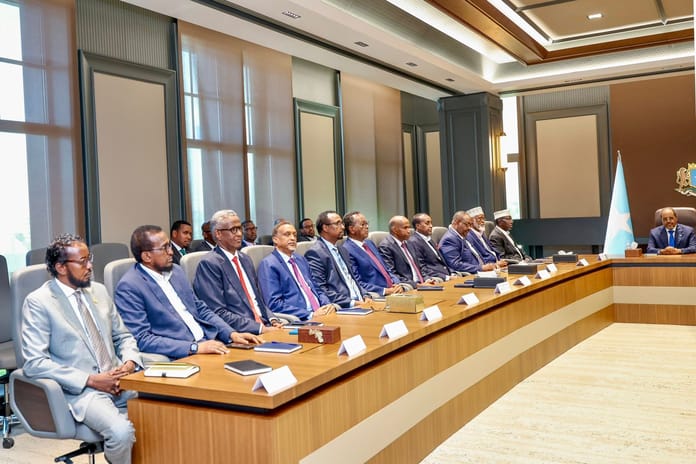
Mogadishu (Somalia Today) – A powerful coalition of Somali opposition figures, lawmakers and civil society leaders on Friday condemned the government’s ongoing constitutional amendments as “illegal,” warning that one-sided changes could push the fragile nation into a deep political crisis.
In a three-page communique, the “Conference for the Defense of the Constitution” accused the country’s top leadership of hijacking the state-building process and ignoring legal procedures ahead of key institutional deadlines.
The gathering in Mogadishu brought together members of the Somali Future Council, federal lawmakers and regional politicians, showing a growing rift over the capital’s push to change the provisional constitution and centralize executive power.
“Any amendment not pursued through legal channels, and without the consensus of federal member states and other political stakeholders, undermines the very purpose of the constitution,” the communique read.
It declared the 2012 provisional constitution to be the country’s only valid legal framework until it is lawfully amended.
Collapsed talks
The opposition’s fierce declaration comes just days after the Somali Future Council officially confirmed the collapse of highly anticipated dialogue with the federal government.
Talks broke down earlier this week after the opposition accused President Hassan Sheikh Mohamud’s administration of pushing forward with unilateral amendments, despite opposition demands to pause the overhaul as a precondition for negotiations.
Representatives cited a profound “trust deficit,” alleging the government was utilizing security pressures to undermine the negotiation process while refusing to compromise on the management of upcoming federal and regional polls.
The recent collapse is the latest in a long string of failed political negotiations that have paralyzed Somali state-building.
For the past two years, the National Consultative Council (NCC)—the primary dialogue forum between the federal government and member states—has been severely weakened.
The semi-autonomous state of Puntland has boycotted the NCC since early 2023, while Jubaland’s leadership has repeatedly walked out of summits, citing federal overreach into regional electoral autonomy.
Friday’s communique highlighted this failure to secure agreements on foundational issues, including the architecture of national security, the structure of the judiciary, public financial management, and the equitable sharing of natural resources.
‘Unlawful’ changes
The conference presented evidence that authorities unlawfully blocked more than 50 lawmakers from attending parliamentary sessions because they opposed the overhaul.
Participants accused the president—constitutionally mandated as the charter’s guardian—and parliamentary leaders of violating the separation of powers and ignoring calls for a consensus-based review led by independent experts.
The communique also highlighted the government’s failure to secure agreements between the federal government and federal member states on foundational issues.
Those unresolved disputes include the structure of national security, the judiciary, public financial management, and the fair sharing of natural resources and revenues.
Somalia has operated under a provisional constitution since 2012.
The text requires broad public consultation and engagement with federal member states for any amendments, a process that has remained one of the country’s most contested state-building issues.
Rising tensions
Political tensions in Somalia have risen steadily since March 2024, when the federal parliament approved highly controversial amendments to the first four chapters of the provisional constitution.
Those sweeping changes gave the president the power to appoint and dismiss the prime minister without parliamentary approval, extended government terms from four to five years, and introduced direct presidential elections.
The reforms triggered an immediate and severe backlash.
The semi-autonomous State of Puntland fiercely rejected the amendments, announcing it would withdraw from the federal system and act independently until a mutually accepted constitution is approved through a nationwide referendum.
Prominent political figures have also warned that the moves disrupt Somalia’s delicate clan-based power-sharing model, which has been in place for decades.
Mogadishu, however, has long defended the reforms as necessary to build a stable political order and move away from the indirect voting system.
In August 2024, the cabinet advanced a bill aimed at restoring universal suffrage, despite acknowledging major security and logistical hurdles caused by the ongoing Al-Shabaab Islamist insurgency.
The government took a symbolic step in that direction in December 2025, when residents in Mogadishu voted in municipal elections.
Widely seen as a test run for broader democratic reforms, the polls were the first of their kind in the capital in more than half a century, though they excluded Puntland and the breakaway region of Somaliland.
‘Rescue’ gathering
But the fragile political consensus broke down completely in January 2026, when a joint parliamentary session erupted into physical scuffles and shouting matches over proposed new constitutional amendments.
Opposition lawmakers said the proposals were a backdoor attempt to extend parliament’s term by two years, reviving memories of a 2021 constitutional crisis that pushed the capital close to armed conflict.
Pointing to the expiration of the two houses of parliament’s mandate on April 14, and the presidential term in May, Friday’s opposition conference declared that the president had deliberately refused to reach a consensus on the country’s elections.
In response to the deadlock, the forum announced that the Somali Future Council will host a national “rescue gathering” on April 10.
Organizers said the event aims to establish a transitional path, avert a constitutional vacuum, and safeguard Somali statehood.
Deepening drought
The constitutional standoff is unfolding against the backdrop of a severe and fast-worsening humanitarian emergency.
Friday’s communique linked the political dysfunction to the government’s failure to address a renewed drought and hunger crisis, urgently appealing to the international community and the Somali public to provide immediate relief to affected populations.
Currently, about 6.5 million Somalis face acute hunger.
The United Nations and the federal government have warned of deepening hardship, mass displacement, and rising malnutrition.
The World Food Programme recently cautioned that life-saving aid operations could grind to a halt by April without a critical injection of new funding.
The combined pressure of a disputed constitutional overhaul, fast-approaching electoral deadlines, and a climate-driven humanitarian catastrophe leaves Somali leaders navigating one of the most dangerous political chapters in the nation’s recent history.


