
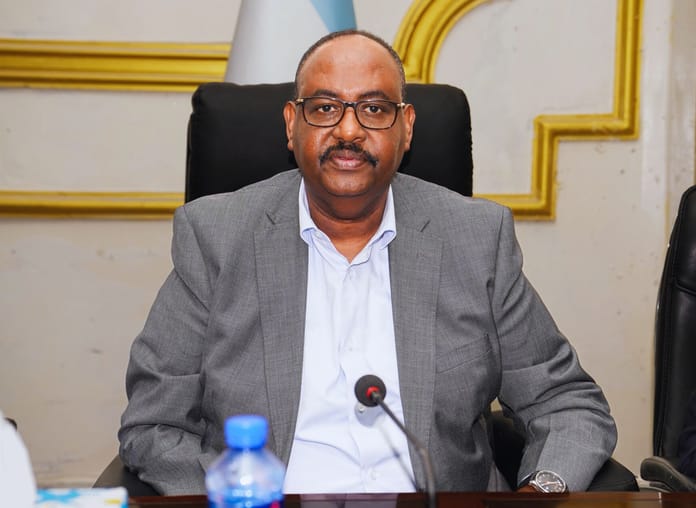
Abu Dhab (Somalia Today) – The leader of Somalia’s semi-autonomous state of Puntland has arrived in the United Arab Emirates for urgent talks, as a deepening diplomatic rift between the federal government in Mogadishu and Abu Dhabi threatens to upend security arrangements in the strategic Horn of Africa nation.
President Said Abdullahi Deni arrived in Abu Dhabi two days ago after spending three days in Addis Ababa, Ethiopia, according to regional officials.
His visit comes amid growing volatility, just days after the Federal Government of Somalia (FGS) said it was annulling military cooperation agreements with the UAE—a move Puntland has strongly rejected as unconstitutional.
Constitutional showdown
The diplomatic standoff has quickly sparked a constitutional crisis inside Somalia’s fragile federal system. On Monday, the Puntland administration released a strongly worded statement rejecting Mogadishu’s decision to cancel the defense and security arrangements.
“The decision announced by the federal cabinet to annul the Bosaso port development project agreements and the security cooperation between Puntland and the UAE is null and void,” the Puntland statement read.
Garowe says that under Article 53 and Article 142 of Somalia’s Provisional Constitution, the federal government cannot cancel international agreements on its own when they directly affect the security and economic infrastructure of a Federal Member State, without prior consultation.
Puntland officials also argue that until Somalia fully harmonizes its constitution, existing state-level powers remain in force.
Bosaso standoff
At the center of the dispute is the UAE’s footprint in Bosaso, Puntland’s commercial capital.
The Emirates have long operated a training facility there for the Puntland Maritime Police Force (PMPF), a unit crucial in the fight against piracy and, more importantly, the Islamic State (IS) faction entrenched in the remote Bari mountains.
Diplomatic sources told Somalia Today that the UAE recently signaled to a third party that it may withdraw from Bosaso.
However, Abu Dhabi also raised serious concerns about the absence of any credible replacement force that could hold the security perimeter and sustain counter-terrorism operations against IS militants.
Tensions intensified when the Federal Government allegedly delivered an ultimatum: the UAE must leave its position in Bosaso before it can retrieve military equipment that the government is currently holding in Mogadishu.
The equipment reportedly includes surveillance drones and ground control stations—assets that have become essential to modern counter-insurgency operations.
Since the ultimatum, activity at the Bosaso facility has largely stopped. No UAE military aircraft have landed at the coastal airport in the last three days, a sign of a possible freeze in operations that security analysts warn militant groups could exploit.
Internal military friction
The diplomatic row has spilled into Puntland’s internal security scene, raising fears of dangerous military maneuvering.
Tensions have risen in Garowe, the state capital, after reports that the Federal Government has started directly registering Puntland security personnel onto the federal payroll—an effort Deni’s administration sees as an attempt to weaken state command structures.
Puntland authorities have responded by deploying additional battalions to Garowe to secure key installations.
President Deni has reportedly issued a directive barring the return of any Puntland soldiers who have registered with the federal entity, with a particular focus on units that had previously deployed to the contested city of Las Anod.
State courts have also reportedly begun issuing arrest warrants for officers suspected of bypassing the state chain of command to take orders from Mogadishu.
Regional geopolitics
Deni’s route—traveling via Ethiopia before continuing to the UAE—highlights the region’s complicated political chessboard.
Relations between Mogadishu and Addis Ababa remain tense after disputes over sea access, and Deni’s outreach to both Ethiopian and Emirati officials points to stronger ties between actors now at odds with the central government in Mogadishu.
The rupture carries clear risks for Somalia’s stability. The UAE has been a major security partner, training thousands of Somali troops.
But the Federal Government’s drive to centralize authority often collides with the autonomy that states like Puntland insist on preserving.
“Puntland led the pushback, saying the federal cabinet cannot unilaterally cancel agreements that operate inside a member state,” the administration reiterated, signaling that the political distance between Garowe and Mogadishu is widening just as the security landscape grows more fragile.
As Deni continues his meetings in Abu Dhabi, attention is on whether the parties can find a compromise that avoids a full security vacuum in Bosaso, or whether the widening split between the center and the periphery will further fracture Somalia’s security apparatus.


