
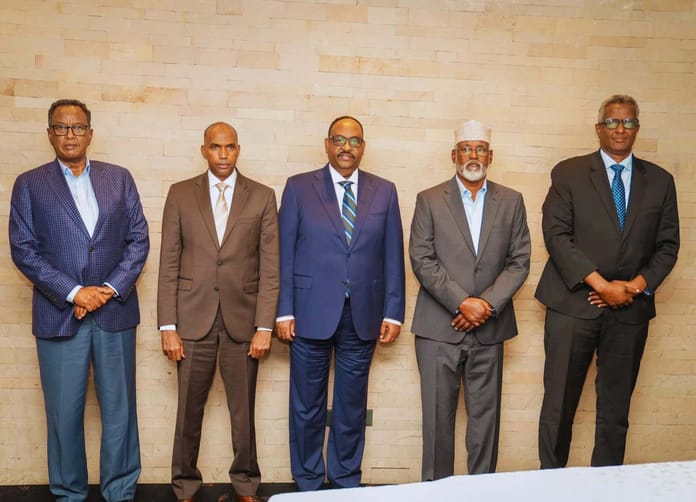
Kismayo (Somalia Today) — A coalition of federal member states and heavyweight opposition figures has completed preparations for a major summit in Kismayo, a senior lawmaker confirmed Wednesday, signalling a dramatic escalation in the standoff with the federal government over the country’s 2026 electoral roadmap.
The conference brings together leaders of Jubaland and Puntland with Mogadishu-based political elites. It aims to form a united front against President Hassan Sheikh Mohamud’s push for a “one-person, one-vote” (1P1V) system.
The administration insists that universal suffrage offers the only constitutional path forward. However, the opposition calls it unrealistic and sees it as a tactic to extend the president’s mandate beyond May 2026.
Yusuf Hussein Gama’did, a Member of Parliament from the Himilo Qaran party, said logistical teams in Kismayo have completed their work. The alliance, operating under the Council for the Future of Somalia, will announce the summit’s opening date within days.
“The organisation of the Kismayo conference is ongoing,” Gama’did said. “The technical committees have finished their work, and the event stands as planned. You will soon see the invitations and official announcement in the media.”
Constitutional deadlock
The Kismayo gathering poses the strongest challenge yet to the National Consultative Council (NCC), which oversees Somalia’s state-building process.
In recent months, the federal government advanced electoral bills and constitutional amendments to replace the “4.5” clan-based power-sharing model with direct polls. Villa Somalia argues this change is essential to build legitimacy.
However, the opposition says the government has not yet laid the groundwork. It cites the absence of a constitutional court, a complete voter register, and secure constituencies free from Al-Shabaab influence.
Without these steps, they argue, the 1P1V model risks becoming a “trap” to delay the vote and keep the administration in power by default.
Jubaland and Puntland, both wielding independent forces and large territories, have already boycotted NCC meetings. The Kismayo summit will, in turn, formalise that break by introducing a rival political charter.
A pragmatic realignment
The Kismayo summit also marks a dramatic realignment in Somalia’s political scene. Leaders who clashed bitterly during the last administration are now finding common cause.
Gama’did confirmed that former President Mohamed Abdullahi Farmaajo can attend the talks. His presence would place him alongside Jubaland’s President Ahmed Madobe—his onetime arch-rival.
Between 2017 and 2022, Madobe led fierce opposition to Farmaajo’s centralisation agenda. Today, both men share a new common opponent: President Hassan Sheikh Mohamud.
“Farmaajo is a former president who governed this country and opposes the current errors,” Gama’did said, rejecting claims that he would be unwelcome in Madobe’s stronghold. “His attendance is up to him. No one has stopped him.”
This unexpected “marriage of convenience” strengthens the Council for the Future. The bloc now merges the federal states’ military leverage with the Somali Salvation Forum’s political networks, creating a coalition capable of stalling federal decisions.
Diplomacy in Nairobi
Meanwhile, the opposition’s campaign stretches beyond Somalia’s borders. Gama’did said the coalition has sent representatives to Nairobi, Kenya, where coordination talks are underway.
Nairobi has long served as a neutral space for Somali political dialogue, away from the tensions in Mogadishu. These meetings involve Jubaland, Puntland, and the National Salvation Forum. Together, they aim to ensure that the Kismayo summit produces binding resolutions rather than mere statements of grievance.
“The Kismayo conference will be the largest opposition gathering to date,” Gama’did said. He added that the event seeks to “address the country’s political crisis” and block any unilateral extension of government power.
However, the formation of such a broad coalition complicates diplomacy for Somalia’s international partners. Western donors and the United Nations have heavily invested in the 1P1V roadmap.
At the same time, foreign missions repeatedly warn against unilateral actions that might destabilise the country. As a result, the new opposition alliance could push donors to intervene, fearing a contested election could undermine the fight against Al-Shabaab.


