
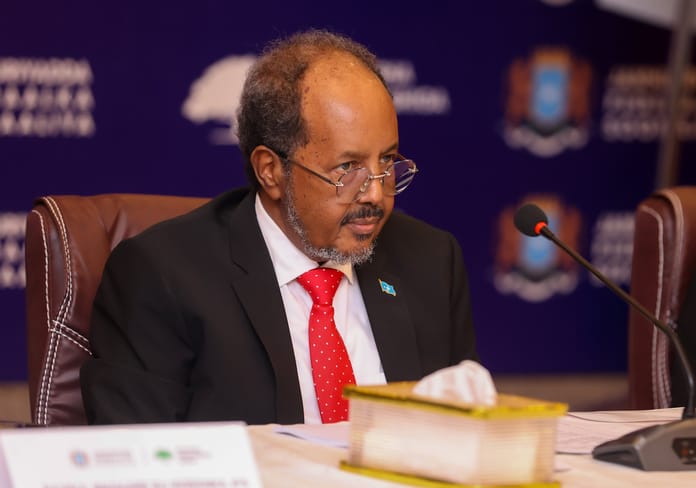
Mogadishu has seen many meetings. Some produced handshakes and headlines; others dissolved into accusations and deeper mistrust. The upcoming engagement between the Federal Government and the opposition must not become another ceremonial gathering. It must be a turning point.
Somalia today stands at a delicate moment. Security gains remain fragile. Political mistrust is widening. Constitutional reforms are contested. External pressures are real. In such a context, prioritization is not procedural—it is existential.
Security first — Politics second
The first and unavoidable item on the agenda must be national security. Al-Shabaab remains a threat not merely to the government but to the Somali state itself. Counter-terrorism efforts cannot succeed if they are perceived as partisan or politically weaponized.
The opposition must commit to depoliticizing the security campaign. The government must commit to transparency, professionalization of the armed forces, and inclusive security coordination with Federal Member States. Without a unified security doctrine, all other political discussions are premature.
A divided political class emboldens violent extremists. A united front isolates them.
Sovereignty is not a campaign slogan
Recent regional developments have raised legitimate concerns about Somalia’s territorial integrity and foreign military engagements. Sovereignty should not be used as a political tool; it should be a shared constitutional principle.
Both sides must adopt a single national position on external agreements and diplomatic engagements. Foreign policy fragmentation between Mogadishu and the Federal Member States weakens the state. Unity on sovereignty strengthens negotiation power abroad.
Elections: Credibility over speed
The debate over one-person-one-vote elections versus indirect models must be resolved through realism, not rhetoric. Elections that lack security, institutional capacity, or consensus risk deepening instability.
The government must clarify timelines, legal foundations, and technical feasibility. The opposition must move beyond rejection politics and present constructive alternatives. What Somalia cannot afford is either unconstitutional term extensions or rushed, contested polls.
Credibility must take precedence over speed.
Constitutional reform requires inclusion
The Provisional Constitution cannot be amended through unilateral political momentum. Any review must include everyone, be transparent, and be based on wide consultation with Federal Member States and key stakeholders.
A constitution built without consensus becomes a source of crisis rather than stability.
At the same time, obstruction is not a solution. Federal Member States and opposition actors carry a constitutional responsibility to actively engage in the review process, clearly state their positions clearly, and contribute constructively to the national dialogue. Participation, not boycott, is the path to influence.
Constitution-making is, by its nature, a process of negotiation, compromise, and mutual recognition. It demands statesmanship over partisanship and dialogue over dominance. The goal must not be victory for one political camp, but durability for the constitutional order.
Federalism is not an enemy
Persistent tension between the Federal Government and Member States undermines governance. Revenue-sharing formulas, natural resource agreements, and intergovernmental dispute mechanisms require clarity and institutionalization.
Federalism is not a threat to unity; mismanagement of federalism is.
The capital question must avoid clan framing
Discussions about Mogadishu’s legal status should be approached through constitutional mechanisms, not clan narratives. The capital belongs to the nation. Any reform regarding its governance must strengthen inclusivity and representation without turning the issue into a zero-sum contest.
A code of political conduct
Perhaps most urgently, Somalia’s political class needs an ethical reset. Personal attacks, inflammatory rhetoric, and clan-coded messaging erode public trust. A jointly signed political code of conduct would signal maturity and responsibility.
The Somali public is exhausted by elite disputes. Citizens demand security, jobs, functioning institutions, and hope.
The moment demands statesmanship
This meeting must not be about who wins the next election. It must be about whether Somalia wins its future.
History will not judge leaders by how loudly they defended their factions. It will judge them by whether they built institutions that outlived them.
Mogadishu does not need another photo opportunity. It needs courage, compromise, and clarity of priorities.
Security. Sovereignty. Credible elections. Inclusive constitutional reform. Functional federalism. Responsible politics.
If these become the pillars of the agenda, the meeting may mark a new chapter. If not, it risks becoming another missed opportunity in a nation that can no longer afford them.
Disclaimer: The views and opinions expressed in this article are those of the author and do not necessarily reflect the official policy or position of Somalia Today.


