
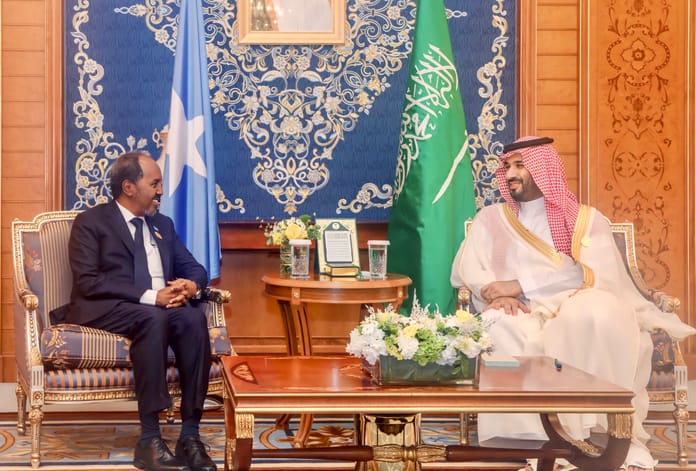
Mogadishu (Somalia Today) — Somalia President Hassan Sheikh Mohamud is expected to travel to Riyadh in the coming days for talks with Saudi Crown Prince Mohammed bin Salman, Somali officials said, as Saudi Arabia prepares to convene Somali leaders on its soil for dialogue aimed at easing internal tensions and bolstering national unity.
Sources in Villa Somalia told Somalia Today that the visit is a strong symbolic gesture by Saudi Arabia to show support for Somalia’s sovereignty, following Israel’s recognition of the breakaway region of Somaliland, amid allegations that the UAE orchestrated the move.
The sources also say Riyadh is preparing a conference to bring together Somali stakeholders inside the kingdom to address domestic disputes and reinforce cohesion. Planning is underway for meetings in the holy cities of Mecca and Medina.
Saudi officials have opened channels with a wide range of Somali actors — including politicians, community leaders, and traditional elders — and figures aligned with both the government and the opposition.
Riyadh wants Somali parties to settle their differences through dialogue, the sources said. Saudi officials are also urging Arab states engaged in Somalia to align around a Saudi-led initiative.
Saudi initiative
Somalia Today sources said Riyadh intends to take a more prominent role in Somalia’s political reset after the president’s visit, framing the effort as a bid to protect Somalia’s unity rather than pursue narrow political bargaining.
Diplomatic contacts have intensified across Arab capitals in recent days to build support for the initiative, the sources said.
They added that once Mohamud returns from Riyadh, Somali stakeholders will begin receiving formal invitations through diplomatic channels, although the conference timeline has not yet been announced.
Saudi outreach, they said, has already reached all major Somali sides in ways that are difficult to ignore.
As relations with Abu Dhabi deteriorate, Somalia has moved quickly to deepen ties with Saudi Arabia, aligning itself more closely with Riyadh’s regional posture, according to Somali officials and regional diplomats.
Somali and Saudi officials have found common cause in opposing what they describe as the UAE’s increasingly assertive footprint across the Red Sea and Gulf of Aden.
Regional diplomats said Mohamud has aligned Mogadishu with Saudi Arabia’s broader containment strategy, as Riyadh grows more concerned about what Saudi officials describe as the UAE’s expanding arc of influence — from the separatist-held island of Socotra in Yemen to ports in Puntland and Somaliland.
In a pointed diplomatic signal, Somali officials in recent weeks have issued statements affirming the “unity of Yemen,” a rebuke to the UAE-backed Southern Transitional Council, which controls large parts of southern Yemen.
Saudi Arabia has also reiterated its full support for Somalia’s sovereignty.
Speaking at an extraordinary meeting of the Organisation of Islamic Cooperation (OIC) foreign ministers in Jeddah, Deputy Foreign Minister Waleed Al-Khuraiji urged the bloc to “categorically” reject Israel’s recognition of Somaliland and to adopt a unified Islamic position against engagement with what he described as separatist entities in Somalia.
UAE ties unravel
The planned diplomatic push comes as Somalia’s federal government resets regional alliances following a sharp collapse in relations with the United Arab Emirates.
Somalia’s cabinet on Monday annulled all security and defence agreements with the UAE, citing violations of “sovereignty, national unity and political independence.”
Ministers also approved a draft law on protecting sovereignty and territorial unity, aimed at closing legal gaps that have allowed foreign powers to bypass Mogadishu through arrangements with regional administrations.
Witnesses and officials said Abu Dhabi has begun pulling personnel and heavy equipment from strategic positions in Somalia, with activity surging at Bosaso airbase in Puntland.
Flight-tracking data cited by Middle East Eye and eyewitness accounts indicate that, on average, around six Il-76 cargo aircraft have landed and departed Bosaso daily in recent days.
Observers described the tempo as resembling an emergency evacuation.
A source at the Bosaso airbase told Middle East Eye that, unlike previous rotations, the flights focused on removing equipment and personnel. The aircraft departed without the usual staging or transfers, the source said.
Somaliland, Yemen fallout
Somali government sources said the rupture followed intelligence assessments accusing the UAE of undermining Somalia’s sovereignty, including allegations that Abu Dhabi helped facilitate Israel’s Dec. 26 recognition of Somaliland, the self-declared breakaway region.
Security officials said the cabinet’s decision also aims to sever logistical links between UAE-aligned actors in Somalia and the war in Yemen.
Regional security analysts have long alleged that the port of Bosaso — where Puntland forces previously received Emirati training — served as a transit hub for supplies destined for pro-UAE factions in Yemen and Sudan’s RSF rebels, allegations that Puntland authorities have previously rejected.
On Thursday, Somalia’s Immigration and Citizenship Agency (ICA) said it had opened an investigation into the alleged “unauthorised use” of Somali airports and airspace, describing the incident as a challenge to national sovereignty and legal procedures.
The announcement followed claims that the Saudi-led coalition accused the UAE of helping STC leader Aidarous al-Zubaidi leave Yemen by boat to Somaliland and then travel onward to the UAE via Mogadishu.
Somalia subsequently suspended United Arab Emirates military flights from transiting its airspace or landing at its airports.
“We are seeing the merger of the Yemen and Somalia conflicts,” said Ahmed Abdi, a Mogadishu-based analyst.
“Mogadishu has concluded that the UAE’s network in Berbera and Bosaso is no longer just about development, but about projecting power in ways that destabilise the federal government.”
Abu Dhabi has not commented on the reported withdrawal or Somalia’s decision to void the agreements.


