
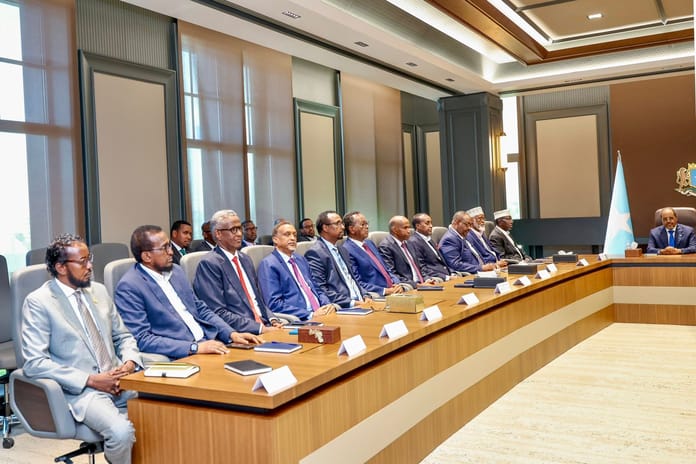
Mogadishu (Somalia Today) – Somali opposition leaders announced the formation of a “National Salvation” platform on Monday following meetings with influential Hawiye traditional elders.
They warned that the country was sliding toward a dangerous constitutional vacuum as political deadlines expired and disputes over the next elections deepened.
The meeting took place at the residence of former president Sheikh Sharif Sheikh Ahmed. Opposition figures briefed elders on what they described as a worsening national crisis following failed talks with President Hassan Sheikh Mohamud.
“We came to tell the Somali people the state the country is in, the stages we went through with President Hassan Sheikh, and where those talks ended,” former prime minister Mohamed Hussein Roble said.
Roble then explained the foundation of the opposition’s main legal criticism in direct language.
“As you know, parliament’s term has ended, and the president’s term ends on May 15,” he said, warning that Somalia was entering “a dark phase.”
‘National Salvation’
The announcement sharply escalates a standoff that has been building for months in Mogadishu.
Opposition politicians accuse Villa Somalia of using constitutional reform and electoral restructuring to prolong its stay in office. The government says it is working to complete Somalia’s long-delayed transition to one-person, one-vote elections.
“From this point on, the country needs a national salvation in which all Somalis take part,” Roble said, calling for a broader political mobilisation.
In another pointed remark, he said the opposition had exhausted private channels with the president.
“We spoke to the president privately and publicly, in kinship and friendship. We told him in every way possible to place the country’s leadership at the centre,” Roble said. “But Somalia is now on the brink of breaking apart.”
The government has framed the same process in a very different language.
After parliament approved the final package of amendments on March 4 and Mohamud signed them into law four days later, the president hailed the move as a “historic day” and described it as “a promise made and kept”.
Officials say the constitutional changes are meant to move Somalia beyond years of transitional politics and lay the foundation for direct elections.
That argument gained momentum in December, when Mogadishu held its first one-person-one-vote local election since 1969.
The government portrayed this as proof that broader universal suffrage is possible.
But the vote was also boycotted by major opposition figures, who said the process lacked consensus and risked concentrating more power in Mogadishu.
Constitutional fractures
The latest crisis stems from that constitutional overhaul, which has opened deep new fractures in Somalia’s already fragile federal order.
Critics argue the amendments could extend the president’s term by a year and delay elections originally scheduled for May, although many contest their legal effect.
That ambiguity is at the heart of the opposition’s campaign. Opponents say the amendments were pushed through without sufficient consensus and have been rejected by key political actors, including Puntland and Jubaland.
Both regions insist that the next transition should still be governed by the 2012 provisional constitution.
Under that reading, parliament’s mandate expired on April 14, while the presidential term ends on May 15.
The dispute has already spilt beyond legal argument into confrontation on the ground. On March 17, South West state said it was suspending ties with the federal government, underscoring the scale of the political rupture.
Less than two weeks later, on March 30, federal troops took control of Baidoa, the largest city in the state, after the regional administration broke with Mogadishu.
Regional president Abdiaziz Hassan Mohamed Laftagareen resigned, residents fled, and aid agencies suspended activities amid fears of clashes.
Those developments have reinforced fears that Somalia’s electoral dispute is no longer just a constitutional fight, but a broader struggle over power-sharing in a federal system still vulnerable to fragmentation.
Echoes of 2021
For many Somalis, the opposition’s call for “national salvation” carries unmistakable echoes of the 2021 crisis, when a disputed term extension triggered armed confrontations in Mogadishu between rival factions of the security forces.
The clashes split sections of the security apparatus along clan lines and forced tens of thousands of people to flee their homes. Parliament later reversed the extension, and Roble moved to steer the country back toward an electoral process.
That precedent still hangs heavily over the current standoff. Analysts and diplomats have long warned that internal ruptures of that kind can hand a strategic opening to the Al-Qaeda-linked Al-Shabaab insurgency.
Al-Shabaab continues to control rural areas and mount deadly attacks despite an extended military campaign against it.
With parliament’s term already expired under one interpretation, the presidential deadline fast approaching, and no agreed electoral framework in place, Somalia now appears headed into another decisive political showdown.
Whether the confrontation ends in compromise or a deeper rupture may depend on whether the rival camps can agree on a constitutional path before the country once again finds itself consumed by a political crisis that overshadows the war against Al-Shabaab.


