
Addis Ababa (Somalia Today) – Ethiopia is covertly funnelling military support to Sudan’s Rapid Support Forces (RSF) from a national army base near the border, according to newly analysed satellite imagery.
Researchers at the Yale School of Public Health’s Humanitarian Research Lab (HRL) identified months of activity consistent with high-level military assistance at an Ethiopian National Defence Force (ENDF) facility outside the western city of Asosa.
The findings provide the first concrete visual evidence that Addis Ababa is actively aiding the paramilitary group in its brutal war against the Sudanese Armed Forces (SAF).
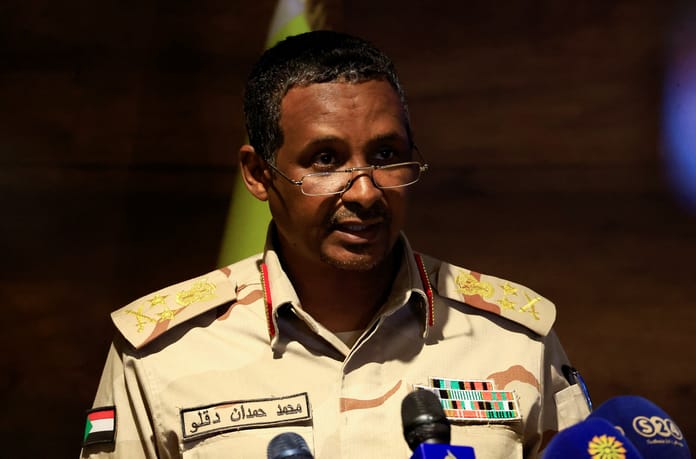
The conflict, which erupted in April 2023 between SAF commander Gen. Abdel Fattah al-Burhan and RSF leader Gen. Mohamed Hamdan Dagalo, has triggered the world’s largest humanitarian crisis, displacing more than 11 million people.
“Since the fall of last year, there have been allegations that Ethiopia has allowed the RSF to base its attacks on the Blue Nile from Ethiopia,” Nathaniel Raymond, executive director of Yale’s HRL, told Middle East Eye (MEE).
“Not only are the Ethiopians assisting the RSF, but they are doing it from an actual Ethiopian army base.”
Satellite evidence
Satellite imagery analysed by Yale HRL shows that support from the Asosa base dates back to at least November.
From December through the end of March 2026, as the RSF launched intense cross-border offensives into Sudan’s Blue Nile state, commercial car transporters regularly moved in and out of the Ethiopian base.
Analysts spotted about 200 technical vehicles at the site in February alone.
Imagery showed that crews had retrofitted unarmed vehicles with gun mounts capable of holding heavy .50-calibre machine guns.
Multiple commercial shipping containers arrived, while workers erected between five and 15 large tents capable of housing up to 150 fighters.
Yale HRL monitored 14 other ENDF bases in the region and found no similar activity, marking Asosa out as a distinct logistical hub.
The Yale HRL report described Asosa as “a key logistics node” ideally placed to provide resupply, refuelling and vehicle maintenance for RSF forces operating inside Sudan.
Emirati link
Diplomatic and intelligence sources indicate that the United Arab Emirates remains the main architect of the covert supply network.
The UAE has long maintained deep ties with the RSF, having previously partnered with the paramilitary group to secure Sudanese gold exports and deploy fighters to the war in Yemen.
Imagery and online videos link the retrofitted vehicles in Asosa to Berbera, a strategic port city in Somalia’s breakaway region of Somaliland that hosts a major Emirati base.
Videos from late 2025 show car transporters carrying identical white and tan technical vehicles from Berbera into Ethiopia.
The logistics route underlines a major geopolitical shift in the Horn of Africa.
In January 2024, Ethiopia infuriated the federal government in Mogadishu by signing a controversial Memorandum of Understanding with Somaliland to secure coastal access.
Somalia subsequently severed agreements with the UAE, further cementing the strategic triangle between Abu Dhabi, Addis Ababa and the breakaway Somaliland republic.
Flight-tracking data also shows multiple UAE-linked IL-76 cargo planes flying from Abu Dhabi to airports in Ethiopia, including Bahir Dar.
At Asosa airport, Yale HRL identified transport aircraft in February and March, including an MI-17 helicopter and a C-130 cargo plane, consistent with those operated by the UAE.
Abu Dhabi has consistently denied supplying the RSF.
The vehicles retrofitted at the Ethiopian base were quickly deployed to the front lines.
Technical vehicles matching the exact dimensions, colour and armament of those at Asosa appeared in footage of recent RSF battles around Kurmuk, a Sudanese border town just 100 kilometres away.
The RSF and allied fighters from the Sudan People’s Liberation Movement-North (SPLM-N) captured Kurmuk in late March after fierce fighting.
Historical tensions
Ethiopia’s willingness to risk international blowback by supporting the RSF stems from deep-rooted domestic and border insecurities.
Tensions between Ethiopian Prime Minister Abiy Ahmed and Sudan’s SAF leadership have simmered for years.
After the outbreak of Ethiopia’s Tigray war in 2020, SAF forces moved to occupy the Al-Fashaga triangle, a fertile border region long disputed by Khartoum and Addis Ababa, sparking deadly border clashes.
Ethiopian officials also accused Burhan of providing covert support to the Tigray People’s Liberation Front (TPLF) during that conflict.
“Tensions between Addis Ababa and Burhan date back to at least 2020,” Goitom Gebreluel, a Horn of Africa political analyst, told MEE.
Gebreluel said Abiy sent a high-level delegation to Sudan last year in an unsuccessful attempt to convince Burhan to abandon support for the TPLF, adding: “These are the primary motivations for Ethiopia’s involvement in Sudan.”
Sudan’s SAF government openly accused Ethiopia of military involvement on March 3.
The RSF, the office of the Ethiopian prime minister and the Ethiopian foreign ministry have declined to comment on the satellite findings.


