
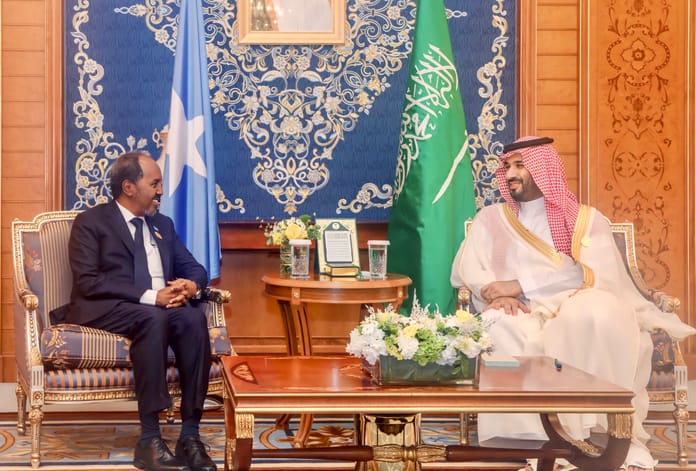
Mogadishu (Somalia Today) – Saudi Arabia is giving Somalia greater strategic weight as Red Sea insecurity, Gulf rivalry, and energy pressures push Riyadh to look more closely at the Horn of Africa, according to a new analysis by the Gulf International Forum.
The article argues that Somalia is no longer a peripheral file for Saudi Arabia. Instead, it says Riyadh increasingly sees Mogadishu through the lens of maritime security, competition with the United Arab Emirates, and the need to protect regional trade and energy routes.
That shift comes amid wider instability across the Red Sea corridor.
Houthi attacks on shipping, growing concern over militant links across the region, and uncertainty over future maritime routes have all increased the value of stability along Somalia’s coastline.
The Gulf International Forum analysis, written by Dr. John Calabrese, says that, for Saudi Arabia, Somalia now matters not only as a fragile neighbour across the Red Sea, but also as part of a wider security arc stretching from the Gulf of Aden to the Red Sea.
Red Sea security
One of the article’s central arguments is that geography is prompting Riyadh to rethink its approach to Somalia.
Somalia’s long coastline sits along one of the world’s most sensitive maritime routes.
That matters more to Saudi Arabia now because the Red Sea has become a more contested and vulnerable space.
The analysis says Somali coastal stability has taken on added importance as threats to shipping have grown and as Saudi Arabia has looked more closely at the security of alternative export and trade routes.
In that reading, Somalia’s value lies not only in what happens on its own territory, but in how insecurity there can affect the wider maritime environment through which Gulf trade and energy flows move.
The article also argues that pressure on regional shipping routes has made Saudi Arabia more sensitive to events well beyond its own shores.
That is one reason, it says, why Riyadh is showing greater interest in Somalia’s security and political direction.
Gulf rivalry
A second theme in the analysis is Saudi Arabia’s rivalry with the UAE.
The article says Riyadh is increasingly positioning itself as a backer of Somalia’s federal government and territorial integrity, while Abu Dhabi has maintained deeper ties with sub-state actors such as Somaliland and Puntland.
That contrast has become more visible in recent years as the UAE expanded its commercial and strategic footprint in places such as Berbera and Bosaso.
For Saudi Arabia, the analysis suggests, Somalia is also part of a wider contest over who gets to shape the political and security order around the Red Sea.
In that context, backing Mogadishu is not simply a diplomatic gesture.
It is also a way for Riyadh to push back against arrangements that strengthen regional actors at the expense of the Somali federal government.
The article argues that Saudi Arabia does not want to leave the Horn of Africa to Emirati influence, especially at a time when Gulf competition has become more layered and more strategic.
That helps explain why Somalia now matters more in Riyadh than it did before.
Rhetoric to action
The piece says Saudi Arabia’s approach is already moving beyond rhetoric.
It points to the military cooperation agreement signed by Somalia and Saudi Arabia in Riyadh on February 9 as evidence that bilateral ties are deepening in more practical ways.
That agreement came as Mogadishu sought stronger regional backing over sovereignty issues and wider security threats.
The article also points to Saudi diplomatic backing for Somalia’s territorial integrity and to Riyadh’s effort to work through multilateral forums such as the Organisation of Islamic Cooperation.
In the author’s view, these steps suggest Saudi Arabia wants a more direct role in shaping the security and political environment along the Red Sea littoral.
For Mogadishu, that could prove significant.
Saudi engagement may bring not only political support but also security cooperation and greater diplomatic weight at a time when Somalia remains vulnerable to both internal and external pressures.
The analysis suggests Somalia may gain leverage from the fact that it is now more relevant to Saudi strategic thinking than before.
Hard realities
Even so, the article is careful not to overstate what Saudi Arabia can achieve.
It notes that Somalia remains politically fragmented and institutionally weak, while Al-Shabaab continues to pose a major threat.
It also says Riyadh is not entering an empty arena.
Turkey, Egypt, Qatar, and the UAE all have active interests in Somalia and the wider Horn of Africa.
That means any Saudi effort to become Mogadishu’s main Gulf partner will unfold in a crowded and contested field.
The article, therefore, presents Saudi Arabia’s Somalia push as an opening, not a certainty.
Riyadh may see a strategic opportunity, but it will still have to operate in a country where political crises, security threats, and competing foreign interests all complicate long-term planning.
That is why the piece presents Somalia as both an opportunity and a test for Saudi policy.
The article’s broader conclusion is that Saudi policy towards Somalia is changing in character.
This is no longer just about aid, diplomacy, or episodic political support.
According to the Gulf International Forum analysis, it is now about strategy: securing sea lanes, managing rivalry with the UAE, protecting energy interests, and helping shape the balance of power around the Red Sea.
If that assessment is right, Somalia’s importance in Gulf politics is rising.


