
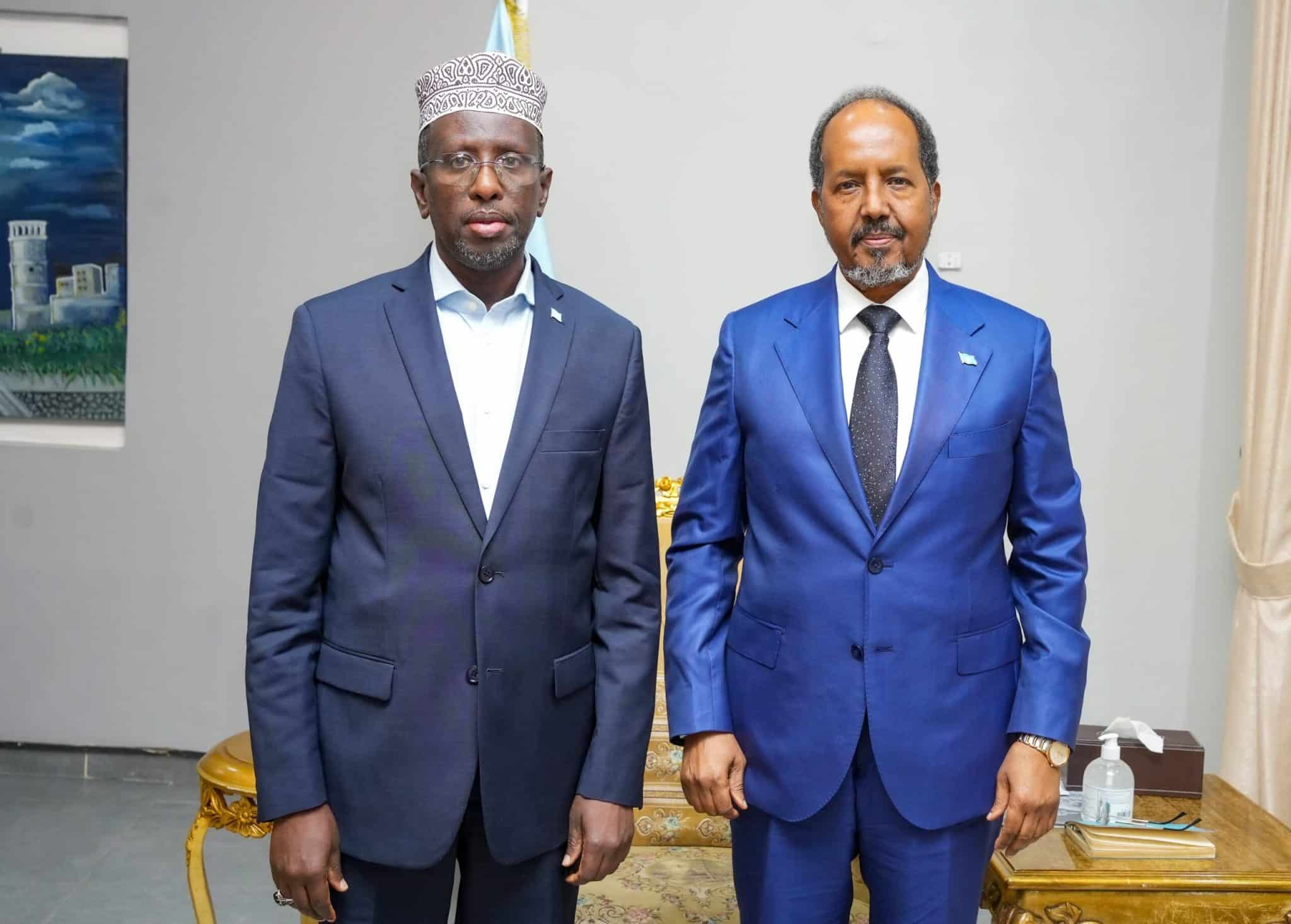
Mogadishu (Somalia Today) — When former president Sharif Sheikh Ahmed publicly donated money to a woman who said she is President Hassan Sheikh Mohamud’s aunt, recently evicted from government land, it was more than charity.
It was a pointed act of political theater, aimed at exposing what the opposition calls the administration’s two core flaws, forced evictions in Mogadishu and alleged nepotism inside the presidency.
But the effort appears to have backfired. Instead of painting Hassan Sheikh as a callous leader, the episode shifted the narrative toward a government seen, at least briefly, as applying the law even handedly regardless of personal ties.
A public gesture loaded with politics
The controversy erupted after Mama Fowsiya, a displaced resident, was evicted from land marked for public use. At a rally organized by Sharif’s Himilo Qaran party, she broke down in tears as she described her ordeal.
“I am Mama Fowsiya,” she said, sobbing before a large audience. “I’ve cried on media, I’ve begged on TikTok. Hassan Sheikh is my nephew; his mother and I are sisters. I have never spoken through clan ties before, but tonight it’s my emotions speaking.”
Her plea drew sympathy online and created an opening that the opposition moved to use.
Sharif rose to respond. “You can all see her emotions have overwhelmed her,” he said.
“The injustice in this country has reached unbearable levels. Our party has decided to give this family one thousand dollars, another thousand for the girl’s education, and to cover her 150-dollar monthly rent.”
He added, “You are not alone. Your rights will be restored, Insha’Allah.”
The moment, part charity and part campaign stagecraft, was built for visibility. Videos spread quickly, casting Sharif as the empathetic elder statesman stepping in where the sitting president had, in the opposition’s telling, failed.
A calculated strike at a vulnerable issue
The timing was deliberate. Forced evictions are among the most contentious issues in Mogadishu.
As the capital expands, poor and displaced families have been uprooted from informal settlements to make way for projects.
Between December 2022 and March 2023, more than 62,000 people were forcibly evicted across Somalia, about 70 percent in Mogadishu. Many say they received little notice and no compensation.
The opposition argues the government is prioritizing construction over compassion.
Sharif’s message resonated with residents angry at displacement. His donation signaled solidarity with the displaced and carried a direct charge that the president’s team had lost its moral compass.
Other opposition figures followed. Lawmaker Daahir Amiin Jeesow told the crowd the president had betrayed kinship and country.
“Your own aunt has cried because of you,” he said. “You’ve displaced your own relatives and your people. We don’t want another civil war; we want peace.”
His remarks captured the mood in the opposition camp, which has been mobilizing protests across Mogadishu. Demonstrations are planned in Dayniile, Tarabuunka, and Siinaay, areas that have been targeted by eviction campaigns.
President Hassan’s calm but firm response
As the story dominated Somali media, President Hassan Sheikh Mohamud addressed the issue on October 3, distancing himself from eviction operations.
He said land management is the responsibility of the Mogadishu municipality, not the presidency.
“The land in Mogadishu is under the responsibility of the local government, just like in Baydhaba, Dhusamareb, Garowe, or Kismayo. If something goes wrong, we will correct it, but the president does not allocate land.”
He outlined a broader urban plan.
“Mogadishu will no longer remain a disaster zone, a place where al-Shabaab hide, where fire brigades cannot reach, where bodies cannot be retrieved. We are reorganizing these areas, opening roads, and enforcing order.”
He also said he was not ashamed of public protests. “I’m not embarrassed that people are shouting; they have the right to. The truth is, change is difficult, but necessary.”
The tone was measured, reframing the evictions as part of city development rather than personal cruelty.
When the narrative turned
The case that the opposition hoped would humanize its cause also blurred its contrast. The eviction of a woman claiming kinship with the president looked to some like evidence of impartial governance rather than indifference.
In a political culture where clan ties often define power, the idea that even the president’s relatives are subject to orders carried weight.
Whether intended or not, the outcome reinforced the rule over the relationship.
This episode adds to a rivalry that has shaped much of post-transition politics. Mohamud defeated Sharif in the 2012 presidential race.
They later united against former president Mohamed Abdullahi Farmaajo, then split again after Mohamud’s 2022 victory.
Sharif and allies accuse Mohamud of a winner-takes-all approach and of excluding former partners.
The eviction affair is now another front in that contest, one in which Sharif’s effort to project moral authority bolstered the president’s claim of institutional control.
A lesson in political irony
The story of Mama Fowsiya shows how human suffering, rivalry, and perception intersect.
Sharif Sheikh Ahmed highlighted a genuine grievance, the harm caused by forced evictions. But his attempt to turn that pain into political pressure produced an unintended result.
Instead of weakening President Mohamud, it allowed him to appear, at least for a moment, as a leader under whose government even family ties bring no special protection.
The core issues remain: land rights, corruption, and governance.
For now, a gesture meant to expose weakness has provided a brief moment of strength for the presidency.


