
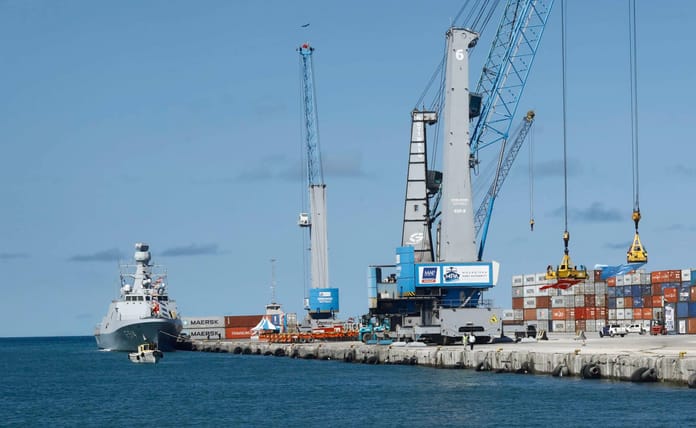
London (Somalia Today) — Somalia plans to start building a new international-standard seaport in Mogadishu next year, the country’s ports minister told a global maritime gathering in London, saying the project should turn the capital into a regional transit hub and free zone.
Abdulkadir Mohamed Nur announced the plan during the 34th session of the International Maritime Organization’s Assembly and said the facility will connect directly to global shipping networks rather than serving only domestic trade.
He said the new port will include a regional transit hub and a free zone designed to attract logistics firms, warehousing, and light industry to Somalia’s long coastline.
“It will be a very large port, designed to connect Somalia not only regionally but internationally,” Nur said in remarks reported by Anadolu Agency and carried in a recent announcement.
Officials have not yet released the project’s cost, the exact site along Mogadishu’s shoreline, or a detailed construction schedule. But Nur cast the plan as the next step after a push that has already lifted Mogadishu’s existing port to the top of regional efficiency rankings.
Port upgrades
Mogadishu’s current seaport is Somalia’s main maritime gateway. It handles almost all containerised imports and exports of livestock, bananas, and other goods. For years, it struggled with congestion, ageing cranes, and days-long queues at anchorage.
Nur said that the picture has changed. The port now runs 24 hours a day, a shift that he said has sharply cut ship waiting times and eased city traffic as trucks move during off-peak hours.
In 2020, some vessels waited several days to unload containers; authorities now put the average at roughly six hours.
Daily container handling has risen by about 20 percent, with plans to increase it to 50 percent as new equipment and systems come online.
The terminal, operated under concession by Turkish company Albayrak Group, has already expanded its annual capacity from 150,000 twenty-foot equivalent units (TEUs) to 180,000 TEUs this year and aims to reach 250,000 TEUs.
Port officials link those gains to a new container terminal and a fleet of modern cranes and reach stackers that they say have almost doubled Mogadishu’s cargo-handling power.
Regional benchmark
The upgrades helped drive Mogadishu’s rise in the 2024 Container Port Performance Index, a global ranking compiled by the World Bank and S&P Global Market Intelligence.
In September, Somali officials said the index ranked Mogadishu as East Africa’s most efficient port and 163rd worldwide out of 407 facilities.
The index measures how long ships stay in port, from arrival at anchorage to departure, making it a key signal for shipping lines that want to avoid costly delays.
Ambassador Mohamed Ali Nur, director general of the Mogadishu Port Authority, said at the time that the ranking proved “competitiveness is possible without major infrastructure investment” and reinforced Somalia’s claim to be a serious trade gateway after decades of conflict.
Speaking in London, Minister Nur argued that this performance gives Mogadishu room to think bigger. “From this perspective, we don’t really need competition — we are already number one,” he said, in a clear nod to regional rivals such as Mombasa, Djibouti, and Berbera.
Türkiye partnership deepens
The new port plan also underscores Somalia’s rapidly deepening economic and security partnership with Türkiye.
Albayrak has operated Mogadishu Port for more than a decade, investing in terminals, equipment, and systems as part of Ankara’s wider infrastructure presence in Somalia.
In February 2024, the two countries signed a 10-year defence and economic cooperation pact that covers naval training, joint maritime patrols, and revenue-sharing from offshore resources.
Somali and Turkish officials say the deal aims to boost Somalia’s ability to police its waters against piracy, illegal fishing, and regional encroachment.
Somalia’s government now presents ports, blue-economy projects, and coastal infrastructure as core pillars of that relationship.
State media said a recent meeting between Nur and Turkish President Recep Tayyip Erdogan in Ankara focused heavily on port expansion and maritime security.
Horn of Africa race
The Mogadishu announcement comes as governments across the Horn of Africa race to secure deepwater access to the Red Sea and the Gulf of Aden.
Landlocked Ethiopia has sought port deals in neighbouring territories, including a disputed 2024 memorandum with Somaliland that triggered a sharp row with Mogadishu before Turkish mediation produced the Ankara Declaration later that year.
Somali officials argue that upgrading Mogadishu and other federal ports strengthens their case that any agreements involving the Somali coastline must go through the federal government rather than breakaway regions.
Analysts say a new port, if built on time and to the standards Nur promises, could give Somalia a stronger hand in that regional contest by offering shippers a larger, more modern gateway in the capital itself.
Big questions remain over how the project will be financed, which foreign partners will join beyond the current operator, and whether security in and around Mogadishu can reliably support such a large build.
For now, Nur is banking on the combination of better performance at the existing port, a rare global efficiency ranking, and the spotlight of the IMO Assembly to draw investors and reassure shipping lines still wary of Somali waters.
“Our business community is very satisfied with these developments,” he said of the current upgrades. “Now we want to move to the next level.”


